Advances in Energy Resolution and Non-Proportionality in Scintillator Detectors (1998-2013)
130 likes | 268 Vues
This collection of research spans from 1998 to 2013, discussing crucial developments in scintillator detectors, particularly in energy resolution and non-proportionality. Key studies include the impact of secondary electron scattering on intrinsic resolution, the influence of light pulse components, and the role of impurities in undoped NaI and CsI scintillators. Significant findings from various papers and conferences highlight the correlation between non-proportionality and intrinsic resolution across multiple scintillator materials, informing advancements in detection technologies.


Advances in Energy Resolution and Non-Proportionality in Scintillator Detectors (1998-2013)
E N D
Presentation Transcript
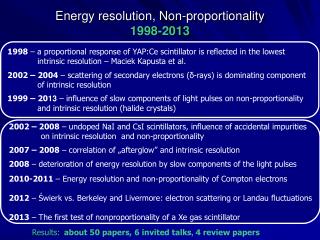
1998 – a proportional response of YAP:Ce scintillator is reflected in the lowest intrinsic resolution – Maciek Kapusta et al. 2002 – 2004 – scattering of secondary electrons (δ-rays) is dominating component of intrinsic resolution 1999 – 2013 – influence of slow components of light pulses on non-proportionality and intrinsic resolution (halide crystals) Energy resolution, Non-proportionality1998-2013 2002 – 2008 – undoped NaI and CsI scintillators, influence of accidental impurities on intrinsic resolution and non-proportionality 2007 – 2008 – correlation of „afterglow” and intrinsic resolution 2008 – deterioration of energy resolution by slow components of the light pulses 2010-2011 – Energy resolution and non-proportionality of Compton electrons 2012 – Świerk vs. Berkeley and Livermore: electron scattering or Landau fluctuations 2013 – The first test of nonproportionality of a Xe gas scintillator Results: about 50 papers, 6 invited talks, 4 review papers
Nonproportionality of Compton electrons LYSO – 2 x 2 x 2 cm3 Nonproportionality of Compton electrons and full energy peaks. Curves are normalized to 662 keV full energy peak of Cs-137. close geometry: ~ 1- 6 cm large solid angle: ≤ 90º weak sources: ~ 10 - 30 μCi
What is the origin of the contribution of the secondary electrons to the intrinsic resolution of the scintillators? • According to Steve Payne and Bill Moses (Livermore • and Berkeley), the Landau fluctuations are responsible • for the intrinsic resolution of scintillators. • see S.Payne et al., „Nonproportionality of Scintillator Detectors: • Theory and Experiment. II.”, IEEE TNS vol. 58, no. 6, pp. 3392, 2011 • According to Swierk group the dominating process is related to the scattering of electrons (-rays).
Electrons in matter: Electrons often undergo large angle deflections loosing large part of energy and producing -rays
Correlation between NP and intrinsic resolution (at 662 keV) LSO, LYSO: 6.8 – 8% GSO, LGSO: 4.5 – 5.5% LaBr3, LaCl3: 1.8 – 2.6% TNS 54 (2007) 3 – A. Nassalski et al.
Intrinsic resolution vs nonproportionality Swierk data Following I. Khodyuk and P. Dorenbos, IEEE TNS calculated between 10 keV and 662 keV
K-dip spectroscopy Intrinsic resolution at 662 keV LSO, LYSO: 6.8 – 8% GSO, LGSO: 4.5 – 5.5% LuAG:Pr: 2.6% Nonproportionality curvesat low energies with similar slopes weak correlation with intrinsic resolution TNS 57 (2010) 1175 – I.V. Khodyuk et al.
Fast and thermal neutron detection in liquid scintillators n/ discrimination with B-10 loaded liquid scintillators A 2D plot of ZC time vs. pulse height measured with EJ309B5 under irradiation of Pu-Be and 241Am. BC523A2 – n/ discrimination L. Swiderski, et al., IEEE TNS – 3 papers, NIM A – 1 paper, osiągnięcie IPJ w 2010
Neutron/gamma discrimination in plastics See Asia Iwanowska, IEEE NSS-MIC 2013
Large samples of plastic scintillators neutron/gamma discrimination See Asia Iwanowska, IEEE NSS+MIC 2013
Ochrona kraju i monitoring przejść granicznych Kontrakty IAEA Euritrack, MODES, TAWARA AiD, Medycyna Projekt BIOCARE Akcja COST Zastosowania • Przemysł • Ekspertyzy dla: • - ICx (d. Target) • Photonis • Projekt „Cement” NOWOŚCI Wspólny detektor dla tomografii PET/CT Super timing w TOF PET SiPM w spektrometrii gamma z scyntylatorami
Common PET/CT detector LSO pixels (2x2x15mm3) coupled to Hamamatsu S8550 APDarray Antoni Nassalski „Common PET/CT detector” PhD thesis Am-241 59.6 keV