

SlideServe
Menu
Préférences
© SlideServe · v2026

AVIAN INFLUENZA

jaron avatar
15 diapositives · 705 Views · Sep 12, 2014

AVIAN INFLUENZA. Vivek K. Introduction. Avian influenza or Avian flu , or Bird flu refers to " influenza caused by viruses adapted to birds . H5N1 strain can infect human First noted in 1997. Current status of Avian Influenza in Poultry. How Human to Human Transmission Occurs.
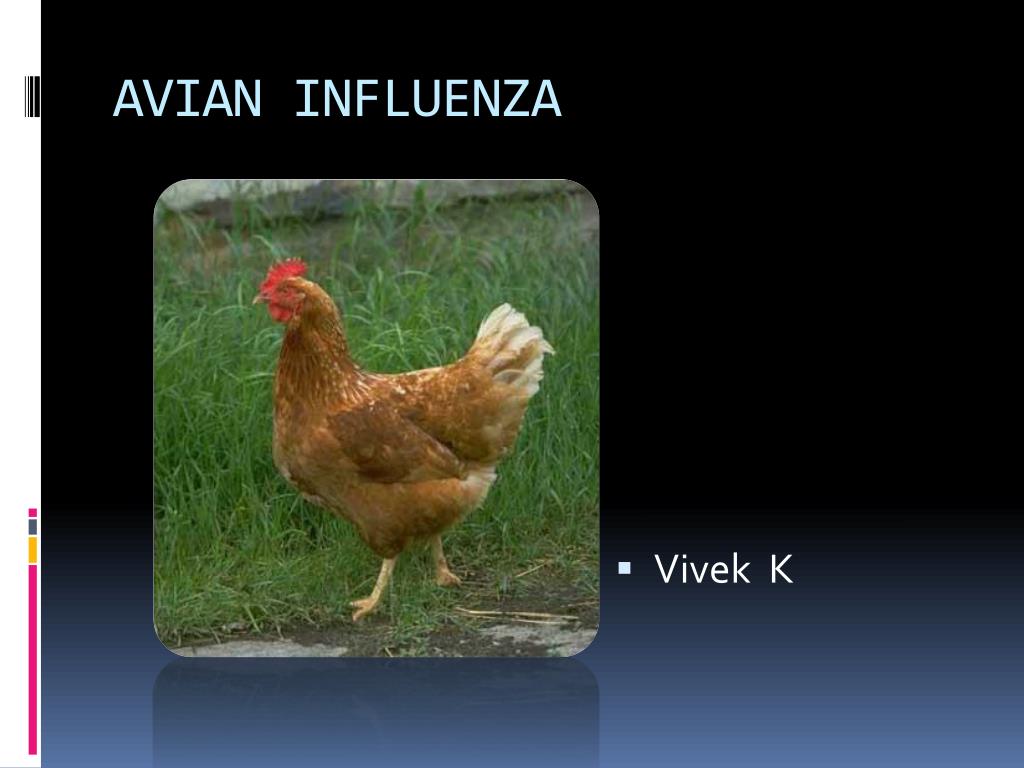
AVIAN INFLUENZA - slide 1
01 / 15AVIAN INFLUENZA
1 / 17

Télécharger la présentation

AVIAN INFLUENZA
Une image / un lien ci-dessous est fourni (tel quel) pour télécharger la présentation

Politique de téléchargement : le contenu du site vous est fourni TEL QUEL pour votre information et votre usage personnel ; il ne peut être vendu, concédé sous licence ni partagé sur d’autres sites sans l’accord de son auteur.Le contenu vous est fourni TEL QUEL, pour votre information et votre usage personnel uniquement. Téléchargez la présentation en cliquant sur ce lien. Lors du téléchargement, si vous ne parvenez pas à télécharger une présentation, l’éditeur a peut-être supprimé le fichier de son serveur.Pendant le téléchargement, si vous ne parvenez pas à obtenir une présentation, le fichier a peut-être été supprimé par l’éditeur.

F I N

Plus de contenu associé

Transcription de la présentation
  1. AVIAN INFLUENZA • Vivek K

  2. Introduction • Avian influenza or Avian flu, or Bird flu refers to "influenza caused by viruses adapted to birds. • H5N1 strain can infect human • First noted in 1997

  3. Current status of Avian Influenza in Poultry

  4. How Human to Human Transmission Occurs

  5. Recent Human Infections by Avian flu

  6. Why are we so concerned? • Number of affected countries with avian influenza increasing • Number of avian and human cases increasing • The majority of the human population has no immunity • High case fatality rate • Human influenza viruses are circulating in Asian countries • Potential of emergence of a new influenza virus Increasing risk of human to human transmission with pandemic potential

  7. WHO Pandemic Phases Inter-pandemic Period • Phase 1: no novel influenza virus subtypes detected in humans • Phase 2: same, but circulating animal virus posing significant risk to humans Pandemic Alert Period • Phase 3: human infection with a novel subtype but no h-t-h transmission • Phase 4: small cluster with h-t-h transmission • Phase 5: larger cluster with h-t-h transmission, virus becoming increasingly adapted to humans (substantial pandemic risk)

  8. WHO Pandemic Phases (cont’d) Pandemic Period • Phase 6: Increased and sustained transmission in the general population Post Pandemic Period • Return to Inter-pandemic Period

  9. Signs & Symptoms Fever. Headache. Tiredness (can be extreme).Dry cough. Sore throat.Nasal congestion. Body aches.

  10. Laboratory Diagnosis • Identification of the agent • Live birds – tracheal swabs and cloacal swabs or faeces • Dead birds – organs and faeces • Serology • Clotted blood samples or • serum 

  11. Tests available: • ELISA: • AGID (Agar Gel Immunodiffusion test) • HI (Haemagglutination Inhibition test) • IFT (Immunofluoresence test) • RT-PCR (Reverse-transcriptase polymerase chain reaction)

  12. Prevention and Control • 1. Cullers and transporters should be provided with appropriate personal protective equipment: • Protective clothing, with an impermeable apron or surgical gowns • gloves must be disinfected. • respirator masks are preferred. Standard well-fitted surgical masks should be used if respirators are not available. • Goggles. • Rubber or polyurethane boots that can be disinfected or protective foot covers that can be discarded. 2. All persons who have been in close contact with the infected animals should wash their hands frequently with soap and water. Cullers and transporters should disinfect their hands after the operation. • 3. Environmental clean up should be carried out in areas of culling.

  13. Treatment Rest. Drink plenty of liquids. Avoid using alcohol and tobacco. Take medication to relieve the symptoms of flu

  14. Drugs • Amantadine • Zanamivir • Oseltamivir

  15. Thank You