Understanding Order of Operations Through Practical Examples
Learn to evaluate expressions by following the correct order of operations, using parentheses to prioritize calculations. Solve problems involving multiple operations step by step to gain a solid understanding of mathematical principles.

Understanding Order of Operations Through Practical Examples
E N D
Presentation Transcript
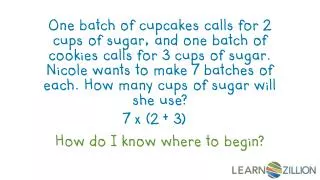
One batch of cupcakes calls for 2 cups of sugar, and one batch of cookies calls for 3 cups of sugar. Nicole wants to make 7 batches of each. How many cups of sugar will she use? 7 x (2 + 3) How do I know where to begin?
In this lesson you will learn to evaluate an expression by interpreting parentheses as “do this first.”
…but I know there is a required order of operations to follow The first operation I see is subtraction… 25 - 12 _ 3 x 6
25 - 12 _ 3 x 6 25 - 4 x 6 25 - 4 x 6 25 - 24 1 25 - 12 _ 3 x 6 = 1
One batch of cupcakes calls for 2 cups of sugar, and one batch of cookies calls for 3 cups of sugar. Nicole wants to make 7 batches of each. How many cups of sugar will she use? 7 x (2 + 3)
2 7 x ( + ) 3
7 x (2 + 3) 7 x (2 + 3) 7 x (Do this first!) 7 x (2 + 3) = 35 7 x (5)
Bob had $30 to pay for his breakfast and lunch on a two day trip. Each day he spent $3 on breakfast and $7 on lunch. How much money did he have left at the end of the trip? 30 - [(3 + 7) x 2]
Bob’s money - breakfast and lunch x 2 days $30 x 2 - $3 + $7 ( ) $30 - [($3 + $7) x 2] Total amount Bob spent
Do I multiply first? 30 - [(3 + 7) x 2] Do this first!
Parentheses ( ) 30 - [(3 + 7) x 2] 30 - [(10) x 2] 30 - [10 x 2] Brackets [ ] 30 - 20 30 -20 = 10
In this lesson you have learned to evaluate an expression by interpreting parentheses as “do this first.”