Understanding Organic Chemistry: Carbon and Its Crucial Role in Life
Explore the fundamental concepts of organic chemistry by delving into the significance of carbon, the key element of life. Learn about organic molecules, monomers, and polymers, as well as the diverse types of organic compounds such as carbohydrates, lipids, proteins, and nucleic acids. Understand the roles these macromolecules play in our biological processes, including energy provision, structural functions, and genetic coding. Discover the exciting interactions between these compounds in every living organism.

Understanding Organic Chemistry: Carbon and Its Crucial Role in Life
E N D
Presentation Transcript
Organic chemistry Carbon: the element of life
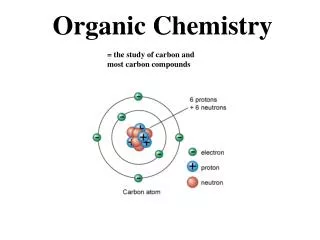
Important Terms to Know • Organic molecule: anything containing carbon • Carbon is an essential molecule in all living things • Can make up to 4 bonds with other atoms- versatile • Monomer: a single unit • Polymer: a structure made of many single units, or monomers • Example: a beaded necklace • The beads are all monomers • The necklace, put together, is a polymer.
Carbohydrates • Carbohydrate monomers are called monosaccharides • Monomer examples • Glucose (C6H1206) • Galactose (C6H1206) • Fructose (C6H1206) • General Structure of the monomer- a ring
Carbohydrates • Functions • Provide short term energy to an organism • Provides structure to cell walls (cellulose) • Polymers
Carbohydrates Fun Facts • The human body can not digest cellulose! • Anyone want to provide evidence for this?
Lipids • Lipids are also known as fats • Monomers are made of (there are no polymers): 1. A glycerol 2. At least one fatty acid tail • Examples of lipids are: monoglyceride, triglyceride, saturated fat, unsaturated fat • General Structure
Lipids • Functions • Provide long term energy to an organism • Provides structure of cell membranes (phospholipids) • Insulation • Saturated vs. Unsaturated fats • Saturated fats have hydrogens at every possible spot (solids) • Unsaturated fats have at least one double bond (liquids)
Lipids Fun Facts
Proteins • Protein monomers are called amino acids • Monomer examples- there are 20 different amino acids • Valine, tryptophan, serine • General Structure of the monomer-
Proteins • Functions (just a few- there are MANY!) • Make up muscle • Make reactions happen faster (catalyst)- ENZYMES • Make antibodies to help you fight infections- ANTIBODIES • Polymers look like this: • they are HUGE and very complex
Nucleic Acids • Nucleic acid monomers are called nucleotides • Monomers (nucleotides) are made up of 1. Nitrogenous base (A, T, C, G- or U in RNA) 2. Phosphate group 3. 5 carbon sugar (either deoxyribose-DNA or ribose-RNA) • General Structure of the monomer-
Nucleic Acids • Functions • Code of life • Central dogma of biology: DNA RNA Protein - - Traits • Polymers
Nucleic Acids • DNA- double helix • RNA- single stranded
Foods? • What foods that you eat contain each of these 4 organic molecules? • Carbohydrates? • Lipids? • Proteins? • Nucleic Acids?