Maximal Independent Set
490 likes | 600 Vues
This article delves into the concept of Maximal Independent Sets (MIS) in graph theory, which consist of non-adjacent nodes. It discusses the characteristics of MIS, Maximum Independent Sets, and their applications in distributed systems, such as in wireless ad hoc networks where they enable parallel processor operations and efficient routing. It also explains a Sequential Greedy Algorithm for finding MIS and introduces a Randomized Distributed Algorithm that improves performance. Additionally, it covers the probability analysis and expected phases for successful execution of these algorithms.


Maximal Independent Set
E N D
Presentation Transcript
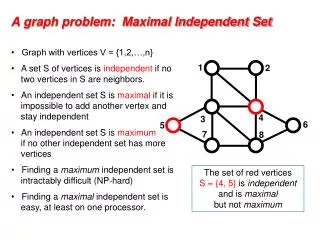
Independent Set (IS): In a graph, any set of nodes that are not adjacent
Maximal Independent Set (MIS): An independent set that is no subset of any other independent set
Maximum Independent Set: A MIS of maximum size A graph G… …a MIS of G… …a MIS of max size
Applications in Distributed Systems • In a network graph consisting of nodes representing processors, a MIS defines a set of processors which can operate in parallel without interference • For instance, in wireless ad hoc networks, to avoid interference, a conflict graph is built, and a MIS on that defines a clustering of the nodes enabling efficient routing
A Sequential Greedy algorithm Suppose that will hold the final MIS Initially
Phase 1: Pick a node and add it to
Phase 2: Pick a node and add it to
Phases 3,4,5,…: Repeat until all nodes are removed
Phases 3,4,5,…,x: Repeat until all nodes are removed No remaining nodes
Running time of the algorithm: Θ(|E|) Number of phases of the algorithm: O(n) Worst case graph (for number of phases): nodes
Homework • Can you see a distributed version of the algorithm just given?
A General Algorithm For Computing MIS Same as the sequential greedy algorithm, but at each phase we may select any independent set (instead of a single node)
Example: Suppose that will hold the final MIS Initially
Phase 1: Find any independent set And insert to :
Phase 2: On new graph Find any independent set And insert to :
Phase 3: On new graph Find any independent set And insert to :
remove and neighbors No nodes are left
Observation: The number of phases depends on the choice of independent set in each phase: The larger the independent set at each phase, the faster the algorithm
Example: If is MIS, 1 phase is needed Example: If each contains one node, phases are needed (sequential greedy algorithm)
A Randomized Sync. Distributed Algorithm Follows the general MIS algorithm paradigm, by choosing randomly at each phase the independent set, in such a way that it is expected to include many nodes of the remaining graph
Let be the maximum node degree in the whole graph 2 1 Suppose that d is known to all the nodes (this may require a pre-processing)
At each phase : Each node elects itself with probability 2 1 Elected nodes are candidates for independent set
However, it is possible that neighbor nodes may be elected simultaneously Problematic nodes
All the problematic nodes must be un-elected. The remaining elected nodes form independent set
Analysis: Success for a node in phase : disappears at end of phase (enters or ) A good scenario that guarantees success No neighbor elects itself 2 1 elects itself
Basics of Probability • E: finite universe of events; let A and B denote two events in E; then: • A Bis the event that A or (non-exclusive) B occurs; • A Bis the event that both A and B occur.
Probability of success in a phase: At least No neighbor should elect itself 2 1 elects itself
Probability of success in phase: At least First (left) ineq. with t =-1 For
Therefore, node disappears at the end of phase with probability at least 2 1
Expected number of phases until node disappears: phases at most
Definition:Bad event for node : after phases node did not disappear This happens with probability (first (right) ineq. with t =-1 and n =2ed):
Bad event for G: after phases at least one node did not disappear This happens with probability: P(ORxG(bad event for x)) ≤
Good event for G: within phases all nodes disappear This happens with probability: (high probability)
Total number of phases: (with high probability) • # rounds for each phase: 3 • In round 1, each node tries to elect itself and notifies neighbors; • In round 2, each node receives notifications from neighbors, decide whether is in Ik, and notifies neighbors; • In round 3, each node receiving notifications from elected neighbors, realizes to be in N(Ik). total # of rounds:
Homework • Can you provide a good bound on the number of messages?