Understanding Episcleritis and Scleritis in Ophthalmology
310 likes | 1.74k Vues
Learn about the differences, symptoms, and management of episcleritis and scleritis in ophthalmology. Understand the clinical features, classifications, and associated systemic conditions of these eye diseases.


Understanding Episcleritis and Scleritis in Ophthalmology
E N D
Presentation Transcript
Episcleritis and Scleritis Dr Anupam Associate Professor Ophthalmology
Applied Anatomy • Sclera forms the posterior five-sixth opaque part of the of the eyeball. • Its whole outer surface is covered by Tenon's capsule and bulbar conjunctiva. • Its inner surface lies in contact with choroid with a potential suprachoroidal space in between.
It is generally thinner in children & females. • Sclera is thickest posteriorly (1mm) and is thinnest at the insertion of extraocular muscles (0.3 mm). • Lamina cribrosa is a sieve-like sclera from which fibres of optic nerve pass.
Microscopic structure 1. Episcleral tissue. 2. Sclera proper. 3. Lamina fusca. Vasculature: 1. Conjunctival vessels 2. Episcleral vessels 3. Deep vascular plexus
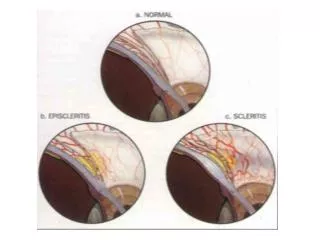
EPISCLERITIS • Benign recurrent inflammation of the episclera, • Common • Benign • Self-limiting • Recurrent • Never progresses to scleritis • Rarely associated with systemic disease
Etiology • Exact etiology is not known. • It is found in association with gout, rosaceaand psoriasis. • It has also been considered a hypersensitivity reaction to endogenous tubercular or streptococcal toxins. Pathology • Histologically, there occurs localisedlymphocytic infiltration of episcleral tissue associated with oedema and congestion of overlying Tenon's capsule and conjunctiva.
Clinical picture • Symptoms. • Redness, mild ocular discomfort, burning sensation or foreign body sensation. • Rarely, mild photophobia and lacrimation may occur.
Signs • Simple or diffuse episcleritis – Sectoral redness – Diffuse redness – Resolves in 1-2 weeks • Nodular episcleritis – Focal, raised, nodular – Sclera uninvolved – Longer to resolve
Vessels remain radial and mobile • Palpation of the globe often elicits marked tenderness in scleritis, but generally not in episcleritis. • Phenylephrine diagnostic test: Hyperemia usually blanches with topical phenylephrine (2.5%) in episcleritis but not in scleritis.
Management • Mild cases – Usually no specific Rx – If discomfort • Lubricant • Topical NSAID egacular (keterolactrimethamine) • Mild topical corticosteroid Or systemic Ibuproven/aspirin Investigate in recurrent cases.
SCLERITIS • Scleritis refers to a chronic inflammation of the sclera proper. It is a comparatively serious disease which may cause visual impairment and even loss of the eye if treated inadequately. • Relatively rarer than episcleritis • Usually bilateral • More common in females • Associated with connective tissue disorders in upto 50% of cases. • Granulomatous inflammation • Mild to blinding spectrum
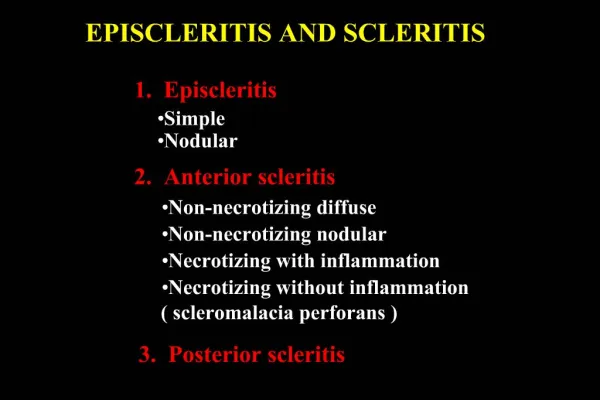
Clinical classification of Scleritis It can be classified as follows: I. Anterior scleritis (98%) 1. Non-necrotizing scleritis (85%) (a) Diffuse (b) Nodular 2. Necrotizing scleritis (13%) (a) with inflammation (b) without inflammation (scleromalaciaperforans) II. Posterior scleritis (2%)
Associated systemic conditions • Rheumatoid Arthritis • 1:200 develop scleritis • Connective Tissue Disease • Wegener granulomatosis • Systemic lupus erythematosus • Polyarteritisnodosa • Ankylosingspondilytis
Associated systemic conditions • Herpes Zoster Ophthalmicus • Metabolic disorders like gout and thyrotoxicosis • Granulomatous diseases like • Tuberculosis, • Syphilis, • Sarcoidosis, • Leprosy • Miscellaneous • Surgically induced • Infectious • Idiopathic
Clinical features • Symptoms • Pain • Redness • Photophobia • Lacrimation • Diminution of vision
Clinical features • Signs 1. Non-necrotizing anterior diffuse scleritis. • Commonest variety, • Widespread inflammation involving a quadrant or more of the anterior sclera. • The involved area is raised and salmon pink to purple in colour
Clinical features • Signs 2. Necrotizing anterior nodular scleritis. • characterised by one or two hard, purplish elevated scleral nodules, usually situated near the limbus • Sometimes, the nodules are arranged in a ring around the limbus (annular scleritis).
Clinical features Signs 3. Necrotizing scleritis with inflammation. • The affected necrosed area is thinned out and sclera becomes transparent and ectatic with uveal tissue shining through it. • It is usually associated with anterior uveitis. 4. Anterior necrotizing scleritis without inflammation (scleromalaciaperforans). • Usually associated with seropositive RA • Painless scleral thinning due to ischaemia.
Posterior Scleritis • Defined as primarily arising posterior to the equator • Painful or painless diminution of vision • Proptosis • Restricted ocular movements • Disc or macular edema • Choroidal folds or detachment • Uveal effusion syndrome • Retinal detachment • Scleral thickening seen on CT or USG B scan.
Investigation 1. TLC, DLC and ESR 2. Serum levels of complement (C3), immune complexes, rheumatoid factor, antinuclear antibodies and L.E cells for an immunological survey. 3. FTA - ABS, VDRL for syphilis. 4. Serum uric acid for gout. 5. Urine analysis. 6. Mantoux test. 7. X-rays of chest, paranasal sinuses, sacroiliac joint and orbit to rule out foreign body especially in patients with nodular scleritis.
Management • (A) Non-necrotisingscleritis. • Steroid eye drops and systemic indomethacin 100 mg daily for a day and then 75 mg daily. • B) Necrotisingscleritis. It is treated by topical steroids and heavy doses of oral steroids tapered slowly. • Immuno-suppressive agents like methotrexate or cyclophos-phamide. • Subconjunctival steroids are contraindicated because they may lead to scleral thinning and perforation
STAPHYLOMAS • Ectasia or bulging of the outer coats (cornea, sclera or both) of the eye with incarceration of the uveal tissue. • Due to weakening of the eye wall resulting from any degenerative or inflammatory condition of the same. • Types: • Anterior (involves cornea) • Intercalary (with in 2mm of limbus) • Ciliary (2-8mm behind the limbus • Equatorial (14mm behind the limbus) • Posterior (posterior to equator)
A: Intercalary staphyloma • B. Ciliarystaphyloma • Equatorial staphyloma • Posterior staphyloma
Management • Treat the underlying cause like, scleritis, RA, vit A def or cornal ulcer. • Local excision and patch graft of cornea or sclera • Enucleation with implant.