Understanding Protists: Exploring the World of Helpful Microorganisms
150 likes | 277 Vues
In this lesson, students will learn about protists, organisms that cannot be classified as animals, plants, or fungi. The agenda includes reading and note-taking from specified textbook pages and engaging with multimedia resources like the "Walking with Dinosaurs" video. Students will also explore the differences between viruses and bacteria, highlighting the beneficial roles of bacteria in various food products and the environment. Assignments will encourage reflection on how these microorganisms impact our daily lives, including digestion and food production.


Understanding Protists: Exploring the World of Helpful Microorganisms
E N D
Presentation Transcript
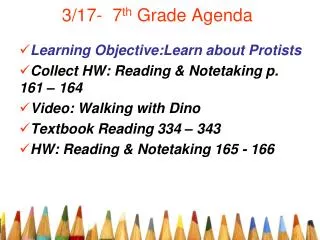
3/17- 7th Grade Agenda Learning Objective:Learn about Protists Collect HW: Reading & Notetaking p. 161 – 164 Video: Walking with Dino Textbook Reading 334 – 343 HW: Reading & Notetaking 165 - 166
Reflection • Prompt: Write 3 differences between virus & bacteria.
Bacteria are helpful • Most bacteria are harmless or helpful to people • Bacteria produces oxy_____, food and med____ • Bacteria also cleans up the environment gen icine
Following food items are made with bacteria der • Apple Ci____ • Vineg___ • Yog___ • Sour Cre____ • Chee____ • Pick_____ • Sourdough Bre____ ar urt am se le ad
What does “Culture” in food labels mean? • The food was made with bacteria
What does “Live, Active Cultures” in food labels mean? • The food was made with bacteria • And the bacteria are still alive
What does “Pasteurized” in food labels mean? • The food has been heated at high temperature to kill most of the disease causing micro-organisms (including bacteria)
Helpful Bacteria in your stomach • Bacteria in your stomach help dig_____ your food, make vita_______ and prevent harmful bacteria from attaching to your intestines. est mins
Protist • Protists are eukaryotes that cannot be classified as anim___, plants or fun___. • Most protists are unicellular but some are multicellular als gi
Animal like Protists • Animal like protist are heterotr_____ and most are able to move from place to place to obtain food • Animal like protist are unicell_____ ophs ular
Animal like Protist (Parameciaum) • How is it like an animal? • How is it NOT like an animal?
Plantlike Protists • Plantlike protists are commonly called algae • Algae are auto_____ can produce sug___ using photosynthesis trophs ar
Why is Algae not a plant? Brown Algae Plant • Algae is not a pla___ because they don’t have the leaf, stem and ro____ structure of plants. nt ot
Red Algae is used in Sushi • Red Algae is used to make ice cr_____, hair cond_______ and sus____ eam itioner hi
Fungus like protists • Fungus like protist are heterotr____, have cell walls, and use spores to reproduce • Slime molds, water molds and downy mildews are examples of fungus like protists ophs