Effective Study
Prepare for your physics exams with this detailed study guide covering essential topics such as circular motion, Newton's laws, momentum, energy mechanics, and electromagnetism. Utilize effective study techniques like mind mapping, flashcards, and practice questions. Understand complex concepts through clear explanations, including centripetal force, torque, reflection, refraction, and electric circuits. Learn to mark and correct your work for clearer understanding. This resource aims to enhance your grasp of physics principles and improve exam performance.

Effective Study
E N D
Presentation Transcript
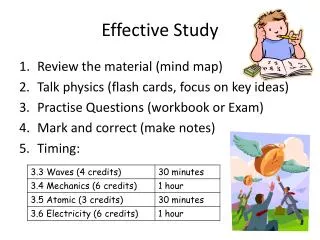
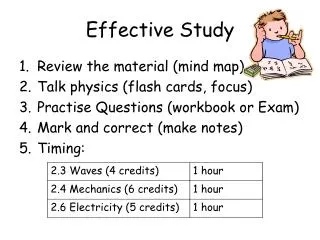
Effective Study • Review the material (mind map) • Talk physics (flash cards, focus) • Practise Questions (workbook or Exam) • Mark and correct (make notes) • Timing:
Circular Motion Centripetal force: caused by friction or tension or gravity Centripetal acceleration: due to a change in direction NOT speed Acceleration Velocity Vectors have direction E 10° S Adding vectors using Pythagoras Don’t forget the angle! Energy Mechanics Separate vertical and horizontal motion Newton’s Laws of Motion Momentum (kg ms-1) p = mv Always conserved (unless acted upon by an unbalanced force) Impulse Δp = Ft Torque (N m) τ = Fd Balance: Clockwise torques = anticlockwise torques 1st: An object will travel at constant velocity unless acted on by an unbalanced resultant force 2nd: Unbalanced resultant force leads to an acceleration F = ma 3rd: Every action has an equal and opposite reaction Friction and air resistance opposes motion
v = fλ , T=1/f f is negative Di, Hi is negative Reflection Longitudinal and Transverse Total Internal Reflection at critical angle Electromagnetic Spectrum Diverging Converging Mirrors & Lenses Refraction: TAG AGA f is positive Di, Hi is positive Diffraction, max if λ= gap longer λ get diffracted more Waves Ray Diagrams Superposition & Interference Standing Waves Interference pattern Constructive (max amp) & destructive (min amp)
Series and Parallel circuit rules Voltage, V, Volts Uniform Electric Field, E Resistance, R, Ohms Current, I, Amps Electric potential energy, ΔE Static Electricity Energy, E, Joules DC Electricity Power, P, Watts Force on a charge in an E-field Electricity Ohm’s Law graphs (V/I) Induced voltage generated across a conductor moving in a B-field & Generators Electromagnetism Force on a charged particle in a B-field DC Motor Force on a current carrying conductor in a B-field (motor effect)