
Expert Guide to Wheel Alignment Angles and Adjustment
E N D
Presentation Transcript
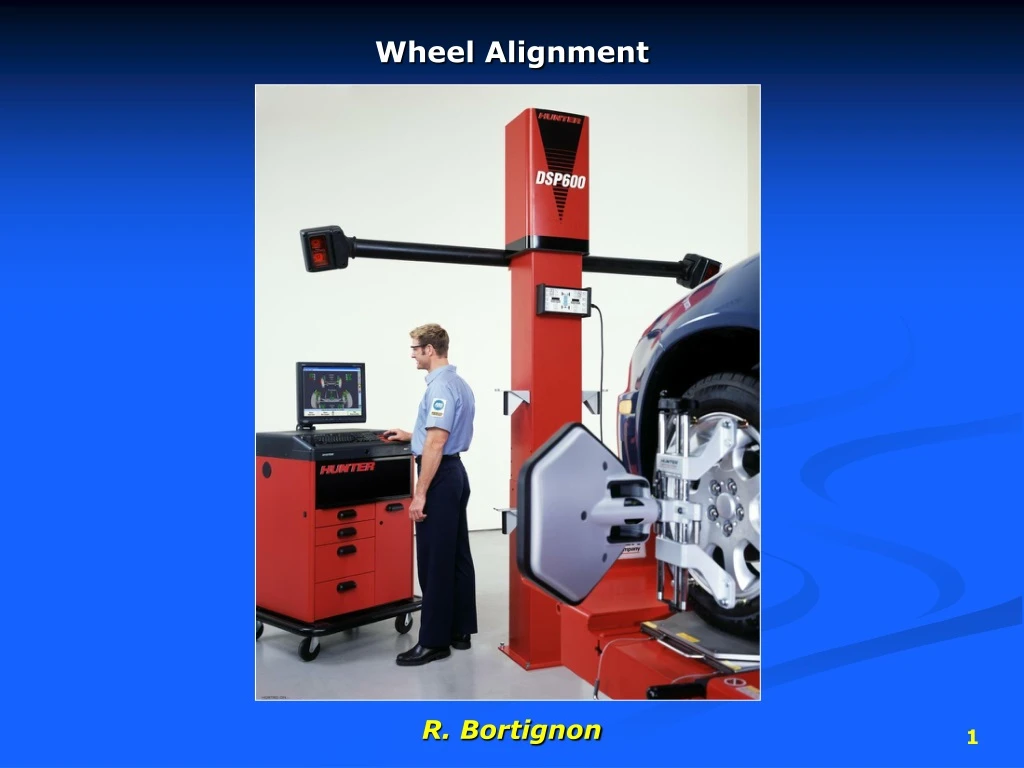
Wheel Alignment R. Bortignon
Wheel Alignment Angles • tire positioning angles are… • caster • camber • toe in or toe out
Caster Angle • caster is the angle created by the tilting of the steering knuckle • visualize line thru upper & lower ball joints or thru the strut • positive caster helps the vehicle travel in a straight line • helps steering wheel return to center after making a turn • caster does not affect tire wear • caster is adjustable on many cars, but not all
Camber Angle • is the tilting of the top of the tire in or out • is used to offset road crown & increase directional stability • camber is a tire wearing angle • camber is adjustable on most cars, but not all • negative camber reduces tire slip when cornering
Toe • toe is the difference in width between the front side of the tires & the back side • toe is used to minimize tire wear & increase directional stability • toe is a tire wearing angle
Adjusting Camber & Caster – shims or slots • double wishbone suspension • shims or slots are used to slide the control arm in or out… • before removing control arm, note the number & position of any shims or mark slot-to-shaft location – this simplifies reassembly
Adjusting Camber & Caster - Eccentrics • double wishbone suspension & struts • eccentrics are rotated to alter caster od camber… • before removing components for repair, mark the position of eccentric – this simplifies reassembly
Toe In/Out Adjustment • tie rod end length changes the toe-in or toe-out
care must be taken when replacing • tie rod ends • MacPherson struts • control arms • that wheel alignment is re-established once components have been reinstalled
regardless of the vehicle, wheel alignment is performed to… • increase tire life • improve handling by maximizing tire contact with road • minimize corrections needed while driving • qualified, knowledgeable technician with modern equipment is essential for correct wheel alignment