
Understanding Gametogenesis: Sperm and Egg Formation
E N D
Presentation Transcript
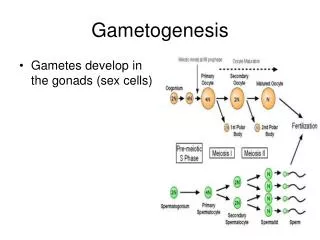
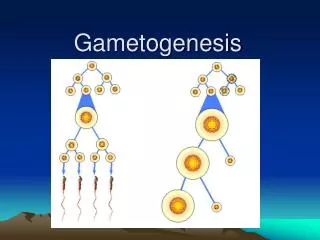
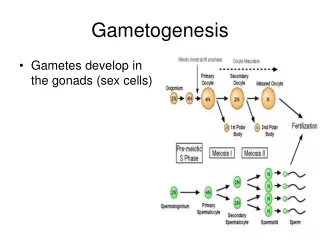
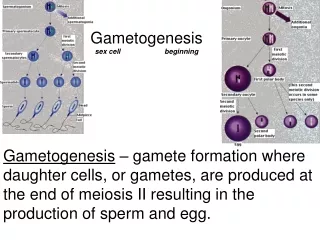
Gametogenesis • The production of gametes in the gonads is known as gametogenesis. • Spermatogenesis is the formation of sperm in the testis. • Oogenesis is the formation of eggs or ova in the ovary.
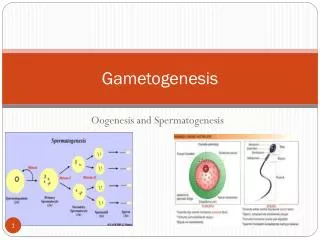
Spermatogenesis • Spermatogonium (2n) are found at or near the basement membrane. • They have a high rate of cell division by mitosis to produce spermatogonia. • The spermatogonium grow to form Primary Spermatocytes which have completed S-phase. • The Primary spermatocytes separate the homologous pairs of chromosomes in meiosis I (reduction division) to form the diploid Secondary Spermatocytes.
The haploid spermatids are formed from the separation of the sister chromatids in meiosis II. • The spermatids are found in association with the Sertoli cells which nourish the spermatids as they differentiate into spermatozoa, and which protects them from the immune system of the male. • The rate of formation of spermatozoa is high and continuous throughout the life of the sexually mature male. • The average number of spermatozoa in ejaculated semen is 32 x 106 ml-1
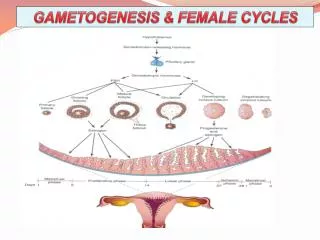
Oogenesis • Oogonium (2n) divide by mitosis to produce many oogonia (this occurs before birth) • Each oogonia grows within the follicle of cells. Meiosis begins but stops in prophase I. The oogonia are found within the primary follicles (formed from the germinal epithelium). • There are approx 400,000 primary follicles present in the ovary prior to puberty.
Oogenesis • Primary follicles (prophase I) may develop to secondary follicles (metaphase II) under the influence of FSH. During puberty primary oocytes undergo the first meiotic division to form haploid secondary oocytes. • The first polar body (haploid set of chromosomes) does not progress beyond metaphase II. • The secondary oocyte begins the secondary meiotic division but does not progress to the end of meiosis unless fertilisation takes place.
Mature sperm • The acrosome is a thin cap over the nucleus of the sperm. The acrosome vesicle contains the enzymes required to digest its way though the ovum wall. • Haploid nuclei (n=23) containing the paternal chromosome set • The 'mid-section' of the sperm contains many mitochondria which synthesise ATP to provide the energy for the movement of the tails structure. • Protein fibres add longitudinal rigidity and provide a mechanism of propulsion.
Mature egg • The haploid nuclei (arrested at metaphase II) sits inside a cell with a large volume of cytoplasm (yolk). • During follicle development unequal division of the cell during meiosis produces the 1st polar body that can be seen outside the plasma membrane. This will not develop. • The zonapellucida surrounds the structure and is composed of glycoproteins. With the cortical granules they will be involved in the acrosome reaction at fertilisation. • Around the outside are the follicular cells.