Proposing Enhanced Aerosol Treatment for CAM4
This document outlines a proposed aerosol treatment for the Community Atmosphere Model version 4 (CAM4) developed by Steve Ghan, Richard Easter, Xiaohong Liu, and Rahul Zaveri at the Pacific Northwest National Laboratory. The goal is to create a computationally efficient representation that captures the complex interplay of natural and anthropogenic aerosols impacting cloud formation, water cycles, and energy dynamics. Current limitations of CAM, including externally mixed aerosol species and prescribed size distribution, will be addressed through improved mechanisms for condensation, coagulation, and scavenging processes.

Proposing Enhanced Aerosol Treatment for CAM4
E N D
Presentation Transcript
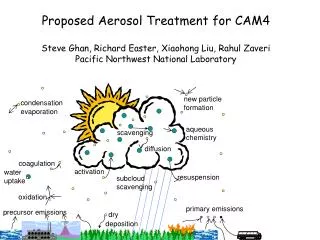
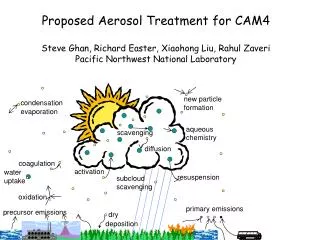
condensation new particle formation evaporation aqueous chemistry scavenging diffusion coagulation activation water uptake resuspension subcloud scavenging oxidation primary emissions dry deposition precursor emissions Proposed Aerosol Treatment for CAM4Steve Ghan, Richard Easter, Xiaohong Liu, Rahul ZaveriPacific Northwest National Laboratory
condensation new particle formation evaporation aqueous chemistry scavenging diffusion coagulation activation water uptake resuspension subcloud scavenging oxidation primary emissions dry deposition precursor emissions Goal: Develop a complete and computationally efficient representation of the aerosol for exploring the competing and complementing mechanisms by which natural and anthropogenic aerosols influence clouds and the cycles of water and energy.
Current Weaknesses in CAM • Aerosol species are externally mixed (individual particles are composed of only a single species).
Current Weaknesses in CAM • Aerosol species are externally mixed (individual particles are composed of only a single species). • Their size distribution is prescribed (number is diagnosed from the predicted mass). • Processes that should only affect mass also affect number. • Processes that only affect number are neglected.
Aitken number sulfate ammonium Proposed Aerosol Treatment for CAM4Steve Ghan, Richard Easter, Xiaohong Liu, Rahul ZaveriPacific Northwest National Laboratory
Aitken number sulfate ammonium Primary Carbon number BC hydrophobic OC Proposed Aerosol Treatment for CAM4Steve Ghan, Richard Easter, Xiaohong Liu, Rahul ZaveriPacific Northwest National Laboratory
Aitken number sulfate ammonium Primary Carbon number BC hydrophobic OC Proposed Aerosol Treatment for CAM4Steve Ghan, Richard Easter, Xiaohong Liu, Rahul ZaveriPacific Northwest National Laboratory coagulation condensation
Aitken number sulfate ammonium Primary Carbon number BC hydrophobic OC Proposed Aerosol Treatment for CAM4Steve Ghan, Richard Easter, Xiaohong Liu, Rahul ZaveriPacific Northwest National Laboratory Accumulation number sulfate ammonium nitrate secondary OC hydrophobic OC BC coagulation condensation
Aitken number sulfate ammonium Fine Soil Dust number soil dust sulfate nitrate secondary OC Coarse Soil Dust number soil dust sulfate nitrate secondary OC Fine Sea Salt number sea salt sulfate nitrate secondary OC Coarse Sea Salt number sea salt sulfate nitrate secondary OC Primary Carbon number BC hydrophobic OC Proposed Aerosol Treatment for CAM4Steve Ghan, Richard Easter, Xiaohong Liu, Rahul ZaveriPacific Northwest National Laboratory Accumulation number sulfate ammonium nitratesecondary OC hydrophobic OC BC coagulation condensation
Aitken number sulfate ammonium Fine Soil Dust number soil dust sulfate nitrate secondary OC Coarse Soil Dust number soil dust sulfate nitrate secondary OC Fine Sea Salt number sea salt sulfate nitrate secondary OC Coarse Sea Salt number sea salt sulfate nitrate secondary OC Primary Carbon number BC hydrophobic OC Proposed Aerosol Treatment for CAM4Steve Ghan, Richard Easter, Xiaohong Liu, Rahul ZaveriPacific Northwest National Laboratory Accumulation number sulfate ammonium nitratesecondary OC hydrophobic OC BC coagulation condensation All modes log-normal with prescribed width. Total tracers: 25 (33)
Aitken number sulfate ammonium Fine Soil Dust number soil dust sulfate nitrate secondary OC Coarse Soil Dust number soil dust sulfate nitrate secondary OC Fine Sea Salt number sea salt sulfate nitrate secondary OC Coarse Sea Salt number sea salt sulfate nitrate secondary OC Primary Carbon number BC hydrophobic OC Proposed Aerosol Treatment for CAM4Steve Ghan, Richard Easter, Xiaohong Liu, Rahul ZaveriPacific Northwest National Laboratory Accumulation number sulfate ammonium nitratesecondary OC hydrophobic OC BC coagulation condensation All modes log-normal with prescribed width. Total tracers: 25 (33) Cloud-borne aerosol predicted but not advected.
condensation Aerosol Processes new particle formation evaporation aqueous chemistry scavenging diffusion coagulation activation water uptake resuspension subcloud scavenging oxidation primary emissions dry deposition precursor emissions
Process Treatment • New particle formation: binary homogeneous • VOC oxidation and condensation separated • Condensation: mass transfer theory • Coagulation: Brownian within, between modes • Renaming from Aitken to accumulation • Scavenging: activation of number and mass for each mode, number depletion by droplet collision/coalescence • Water uptake: Kohler theory for internal mixture, with hysteresis dependent on previous aerosol water • Optical properties: parameterization in terms of wet refractive index and wet surface mode radius
Schedule • March 2006: Select version of CAM to start with • March 2007: Complete application and first simulation • September 2007: Complete evaluation and refinement • December 2007: Complete merge with developmental trunk