
Enhancing Auto-Vectorization in C++ Code for Efficient Computation
This document outlines the challenges and strategies for optimizing C++ code through auto-vectorization, particularly in the context of computational geometry and physics simulations. It discusses the need for code modifications due to translation issues, presents key methods for vector operations, and shares performance insights from benchmarks using Vc library with Intel compilers. The analysis highlights best practices for template-based programming while ensuring effective auto-vectorization, with performance comparisons and recommendations for further optimizations.

Enhancing Auto-Vectorization in C++ Code for Efficient Computation
E N D
Presentation Transcript
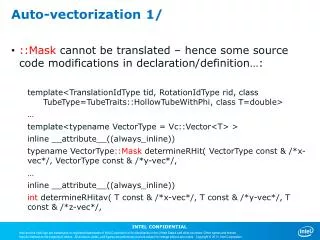
Auto-vectorization1/ • ::Mask cannot be translated – hence some source code modifications in declaration/definition…: template<TranslationIdTypetid, RotationIdType rid, class TubeType=TubeTraits::HollowTubeWithPhi, class T=double> … template<typenameVectorType = Vc::Vector<T> > inline __attribute__((always_inline)) typenameVectorType::Mask determineRHit( VectorTypeconst& /*x-vec*/, VectorTypeconst & /*y-vec*/, … inline __attribute__((always_inline)) intdetermineRHitav( T const & /*x-vec*/, T const & /*y-vec*/, T const & /*z-vec*/,
Auto-vectorization2/ • Source code is still too adherent to Vc • Ex PointIsInPhiSector method: void PointIsInPhiSector(T const & phi1normalx, T const & phi1normaly, T const & phi2normalx, T const & phi2normaly, Vc::Vector<T> const & xcoord, Vc::Vector<T> const & ycoord, typenameVc::Vector<T>::Mask & isinphi) { // method based on calculating the scalar product of position vectors with the normals of the (empty) phi sektor // avoids taking the atan2 // this method could be template specialized in case DeltaPhi = 180^o Vc::Vector<T> scalarproduct1 = phi1normalx*xcoord + phi1normaly*ycoord; Vc::Vector<T> scalarproduct2 = phi2normalx*xcoord + phi2normaly*ycoord; isinphi= (scalarproduct1 > Vc::Zero && scalarproduct2 > Vc::Zero); }
Auto-vectorization3/ • Vc master branch + VecGeom prototypev1 compiled with gcc-4.8.1 + CHEP13Benchmark • For 1024 vector length and 1000 repetition vecnav.DistToNextBoundary() best timing is: ~94ms • Machine is a E5-2697 v2 @ 2.70GHz
Auto-vectorization4/ • Intel Vtune gives the following profile (sampling overhead pushed the 94ms to ~130ms) • Decision to “port” to auto-vectorisationthe PlacedUSolidsTube<tid,rid,TubeType,ValueType>::DistanceToInmethod (hotspot#2). Baseline timing 30ms.
Auto-vectorization5/ • Vc generates very nice asm…
Auto-vectorization6/ • Could not instanciatea PlacedUSolidsTube<tid,rid,TubeType,ValueType>::DistanceToIn method for template parameter = double • Choice was to re-implement another overloaded method for such type:
Auto-vectorization7/ • Not a small kernel; but code is quite easily portable to auto-vectorization: • MaskTypeinz_m = safez > Utils::fgToleranceVc; • done_m= !inz_m && ( z*dirz >= Vc::Zero ); // particle outside the z-range and moving away • … • intinz_m= (safez > Utils::fgTolerance) ? 1 : 0; • intdone_m= (!inz_m && (z*dirz >= 0.0)) ? 1 : 0; // particle outside the z-range and moving away • VectorTypedistanceRmax( Utils::kInfinityVc); • distanceRmax( canhitrmax ) = (-b - Vc::sqrt( discriminant ))*inverse2a; • ValueTypedistanceRmax = (canhitrmax) ? ((-b - std::sqrt(discriminant))*inverse2a) : Utils::kInfinity;
Auto-vectorization8/ • Auto-vectorization timings are not too catastrophic …~40ms vs30ms for Vc (speed-down of 33%) • No arithmetic perturbation visible !? • Same behavior for x10 repetitions • Asm inspection shows partial vectorization for g++ -- need to dig in this direction, as g++ is doing a pretty good job in handling recursive template inlining form out of the box….
Auto-vectorization9/ • With Intel compiler vectorisation seems complete (see next slide for asm inspection), although for the rest of the code embedding Vc template our compiler seems to be lost!
Auto-vectorization11/ • I would recommend to always keep in mind the auto-vectorisation branch in template writing. • Auto-vectorization can be a pain – depending how compiler handles recursive template inlining..Ours seems to do a very poor job – I will initiate an internal review of this code with compiler engineering. • Need also to review reasons of partial vectorization for g++ • Need to test other kernels more complicated • Try this on Haswell(intwill be promoted to 256bits vl) • Try this on MIC • …