Understanding Mass-Mole Calculations for Chemical Formulas
60 likes | 200 Vues
This guide covers the basics of mass-mole calculations using chemical formulas. Chemical formulas represent the types and quantities of atoms in a compound, which is essential for determining the formula mass. By adding the average atomic mass of each element, you can calculate the total formula weight of compounds such as CCl4, NaBr, and Al2O3. Additionally, this guide explains the relationship between moles and formula units, emphasizing that 1 mole equals 6.022 x 10^23 formula units, providing a practical approach to convert mass to moles.


Understanding Mass-Mole Calculations for Chemical Formulas
E N D
Presentation Transcript
Calculating Formula Masses Doing mass-mole-# of particle calculations for compounds
Chemical Formulas • Chemical Formulas are used as a short hand way of describing the atoms that make up a molecule or compound • Chemical Formulas show two things: • Types of atoms (element symbol) • Number of each type of atom in a compound (subscript)
CCl4 NaBr Al2O3 Mg(OH)2 Ca(NO3)2 Ca3(PO4)2 Determine the number of each type of atom in the following compounds…
Formula Weight • The formula mass for a compound is found by adding the average atomic mass of EACH ATOM that appears in the chemical formula • If there are multiple atoms of the same element, the average atomic mass of that atom is multiplied by the number of atoms in the formula
CCl4 NaBr Al2O3 Mg(OH)2 Ca(NO3)2 Ca3(PO4)2 Determine the formula weight for the following compounds…
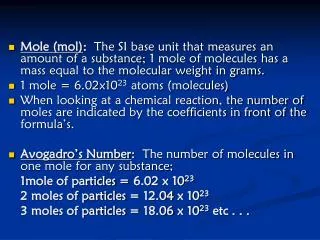
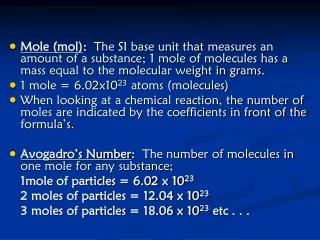
Using the Formula Weight • 1 mol = 6.0221023 things • In the case of compounds, the “things” aren’t atoms, they’re formula units (F.U.s) • 1 mol = (Formula mass) grams of the compound • Formula Mass = Molar Mass for that compound • 6.0221023 F.U.s= (Formula Weight) grams of the compound