Review
This overview highlights the significant events and socio-economic changes from the end of the Civil War through the Great Depression. It covers Reconstruction, industrialization, immigration, and the Gilded Age, leading to the Progressive Movement and significant discrimination issues. The Great Depression's impact, characterized by massive unemployment and a collapsed economy, prompted the New Deal under President Franklin D. Roosevelt. Key programs like the WPA, AAA, and Social Security transformed America’s economic landscape, addressing the needs of citizens and reshaping government involvement in daily life.

Review
E N D
Presentation Transcript
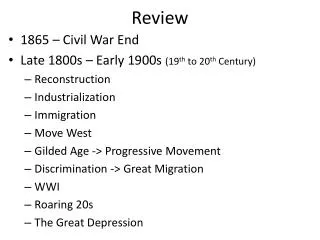
Review • 1865 – Civil War End • Late 1800s – Early 1900s (19th to 20th Century) • Reconstruction • Industrialization • Immigration • Move West • Gilded Age -> Progressive Movement • Discrimination -> Great Migration • WWI • Roaring 20s • The Great Depression
The Fed • The Great Depression • No Jobs • No Banks • NO MONEY • WORLD economy collapses • ANSWER – Gov’t gives money to the people • Federal Reserve (The Fed) = Gov’t bank • US Gov’t borrows money from The Fed • Gets the money to the people • THE NEW DEAL • Franklin Delano Roosevelt (FDR)
FDR is elected US President (1932) • Famous Speech: • “The only thing to fear is fear itself.” • The economy still works • BUT people are worried = not spending • New Deal • WPA • AAA • FDIC • Social Security
FDR’s New Deal • WPA • Public Works Project • Gov’t pays citizens to: • Build Roads, Bridges, Buildings, Schools, etc. • Musicians, artists, writers, actors and directors • AAA • Gov’t pays farmers NOT to plant • Supply DOWN -> Price UP • Farmers no longer living in poverty • FDIC • Gov’t will protect your money in the bank • People feel safe using banks again • Social Security • Everyone must pay into retirement • Elderly and Disabled = money
Meanwhile in Europe… • USA busy fixing our own problems • Fascist Dictators overthrow gov’t in Europe and abuse people • Mussolini (Italy) • Hitler (Germany) • Stalin (Russia) • Franco (Spain) • Military (Japan)
Rise of Dictators • Fascism • Militant Political Movement • Emphasized • Loyalty to the nation (extreme nationalism) • Obedience to the leader • Belief • Do not care about individual rights or democracy • Do not care about communism or capitalism • Its all about making the nation strong • Totalitarian gov’t • Violence, War, and Imperialism are necessary
Fascists Plan • Tariffs (tax on importing/exporting) are preventing trade with other nations • Need to sell to more people • Solution – Conquer new land • Hitler (NAZI Germany) • People Need a Job = Military • Military need something to do – Fight! • Hitler takes: • Rhineland • Austria • Sudetenland • Czechoslovakia