Optimizing Positioning and Handling Techniques for Students with Movement Dysfunctions
340 likes | 463 Vues
This course enhances skills in positioning and handling students with movement dysfunctions to support optimal tone, posture, and functional abilities. Participants will learn effective techniques that facilitate normalized body alignment, prevent deformities, and promote active participation in learning. Key components include understanding body mechanics, demonstrating safe lifting and transferring practices, and applying strategies for encouraging independence in mobility and daily tasks. Practical demonstrations and collaborative activities will ensure participants gain hands-on experience.


Optimizing Positioning and Handling Techniques for Students with Movement Dysfunctions
E N D
Presentation Transcript
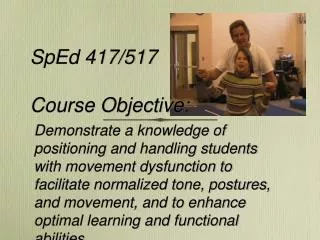
SpEd 417/517 Course Objective: • Demonstrate a knowledge of positioning and handling students with movement dysfunction to facilitate normalized tone, postures, and movement, and to enhance optimal learning and functional abilities
Positioning & Handling Demonstration • Ryan - 21 years old • Spastic quadriplegia cerebral palsy • Cortical blindness
Westling & Fox Chapter 13 • Positioning and handling • Preparation to attain tone normalization and muscle lengthening for body alignment • Control of environmental and sensory influences • Inhibition of primitive reflexes • Facilitation of movement through space • Maintenance of body alignment and muscle length
Westling & Fox Chapter 13 • Body mechanics • Unsafe lifting and transferring can cause permanent damage to lifter and can compromise safety for student • Maintain erect trunk, bend knees, keep load close to body • Plan transfer, arrange environment, decide if assistance is needed
Westling & Fox Chapter 13 • Posture and movement • Key points of control - head, shoulders, trunk and pelvis • Positioning technique • side-lying for increased extensor tone • flexion and rotation for inhibition of extension • stimulate tone of low-toned child to elicit participation • use key points of control
Westling & Fox Chapter 13 • Positioning • Promote active participation • Prevent development or progression of deformities or skin breakdowns • Provide weight-bearing experiences • Facilitate circulatory, respiratory, and digestive functions • Allow mobility
Goals of handling • To elicit normal muscle tone • To facilitate upright positions with normal posture • To facilitate normal movement patterns
Normalizing tone • Health, emotional, and environmental factors • Posture and movement factors
Facilitating normal postures and movement • Normalize tone • Break-up atypical patterns • Use key points of control
Facilitating upright positions and normal posture • Dynamic positioning versus static positioning • Advantages and disadvantages of various • Facilitating automatic movement to maintain balance • Facilitating locomotion for independent mobility • Facilitating arm and hand movements for task performance • Facilitating oral movement for eating and speech.
Goals of positioning • To maintain tone • To maintain body alignment and prevent deformities • To maintain stabilization of body parts • Provide weight-bearing experiences • Facilitate circulatory, respiratory, and digestive functions • To promote active participation in meaningful activity • To allow mobility
Body Mechanics • Determine if student can assist in transfer • If you question your ability to lift/assist alone, ask for help • Assess student abilities and communicate what is happening • Assess the environment, decrease workload • Stay close to student - squat or kneel if necessary • Maintain wide, stable base of support http://www.rehab.on.ca/mobile/transfer/slides/slide1.html
Body Mechanics • Line yourself up with student, maintaining straight back throughout • Never twist trunk while lifting • Use leg muscles when lifting and lowering • Coordinate smooth lift with others - “one, two, three” • Ensure student feels secure throughout
Lifts and Transfers • One-person lift • Two-person lift • Standing pivot transfer • Two person side-to-side transfer • Two person top-bottom transfer • Other options
Positioning, Handling, and Body Mechanics Activity • Working in groups of three, each group will complete the previous lifting and transferring techniques • 40 points will be awarded according to the following criteria • Use of appropriate handling technique • Maintenance of proper body mechanics • Application of lifting/transferring technique • Awareness of mechanical aids • Use of safety precautions