Plural Nouns
Master the art of forming plural nouns in Spanish with this comprehensive guide. Learn how to make nouns plural depending on whether they end in a vowel, consonant, or other specific cases like -ión and -z. Understand the changes in definite articles (el, la) to their plural forms (los, las) when nouns become plural. Explore examples to clarify each rule, such as "libro" to "libros" and "profesor" to "profesores." This resource is perfect for students mastering Spanish grammar.

Plural Nouns
E N D
Presentation Transcript
Plural Nouns Craig Thomas B.A.
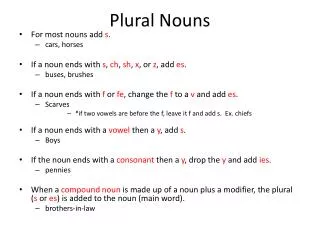
Nouns Ending With a Vowel If a noun ends in a vowel, make it plural by adding -s. • libro: libros • (libro + s) • pluma: plumas • (pluma + s) • chico: chicos • (chico + s) • señora: señoras • (señora + s)
Changing the Article The definite articles (el, la) also change in the plural form. They become "los" and "las." • el libro: los libros • la pluma: lasplumas • el chico: los chicos • la señora: lasseñoras
Nouns Ending With A Consonant If a nounends in a consonant, makeit plural byadding -es. • el borrador: los borradores • (borrador + es) • la universidad: las universidades • (universidad + es) • el profesor: los profesores • (profesor + es) • la ciudad: las ciudades • (ciudad + es)
Nouns Ending In -ión If a nounends in -ión, add -es and dropthewrittenaccent. • el avión: los aviones • la conversación: las conversaciones • la sección: las secciones • la televisión: las televisiones
Nouns Ending in Z Ifa nounends in -z, add -es and changethe z to c. • el lápiz: los lápices • la voz: las voces • el tapiz: los tapices • la actriz: las actrices
Multiple Genders When the plural refers to two or more nouns of different genders, the masculine plural is used. • 2 perros + 6 perras = 8 perros (not perras) • 1 gato + 8 gatas = 9 gatos (not gatas)