Quantum Dot Dynamics: Analyzing Ionization and Distribution Patterns with Phase Grating Techniques
This study explores the complex behavior of coupled quantum dots under varying conditions, utilizing quantum optics and laser techniques. We examine the impact of different wavelengths and configurations, including the use of Fresnel bi-prisms and phase plates, on the ionization processes of localized electrons. The experimental setup incorporates an HE-NE laser and a CCD camera for capturing data on ionization probabilities over defined time steps. Our findings aim to enhance understanding of quantum dot interactions and their potential applications in advanced quantum computing and optoelectronics.

Quantum Dot Dynamics: Analyzing Ionization and Distribution Patterns with Phase Grating Techniques
E N D
Presentation Transcript
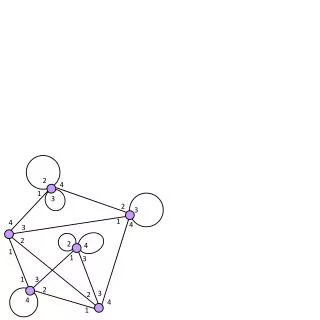
2 4 1 3 2 3 1 4 4 3 2 2 4 1 1 3 1 3 2 3 2 4 4 1
O H H C1 C2 C3 C4 O H H H H
x Gaussian distribution z f (Hz) ? Φ1
X X Y Y EOM f f Y X X Y X Y Y X Y X X Y 0 V1 V2 Const. f EOM2 EOM1 0 V1
Input plate (P1) Image plate (P2) f f f f HE-NE Laser CCD Camera Lens L0 Lens L1 Lens L2 phase grating (G) phase plate (PP) (π retardation) Fresnel bi-prism (FBP)
input H H output
L2 FBP P1 L1 P2 CCD
0.7 0.6 0.5 0.4 Exit probability 0.3 0.2 0.1 0 0 50 100 150 200 250 300 350 400 450 500 Time steps
Ionization np ns 297 nm 1013 nm 480 nm 6p 5p 780 nm F= 2 5s F= 1
Ωlr,j Fl,j Fr,j Source Drain Point Contact (PC) Point Contacts Coupled Quantum Dots PC Gates Drain Initially localized electron • Source Current Quantum Dot (QD)