Integration
This project from Culverhay on September 21st delves into the concept of integration by exploring how to approximate the area under a curve between two ordinates, a and b, using rectangles. As the width of these rectangles decreases, the approximation improves, leading to a better estimation of the area under the curve. Key questions are posed regarding the sequence of areas generated, the properties ensuring convergence of the rectangles to a function, and whether alternative sequences yield the same limit. For further research, refer to "Lebesgue Integration and Measure" by Alan Weir.


Integration
E N D
Presentation Transcript
Integration Newton project, Culverhay, Wednesday September 21st
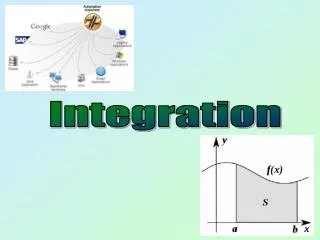
The idea of integration is to find the area under a curve between two ordinates a and b;
The way to do this is to approximate the area by a sequence of rectangles;
Notice, as the width of the rectangles decreases, we get a better approximation to the area;
Finally, the rectangles converge to our original function f(x);
Observe that all the areas, under the rectangles, are bounded by the area under a larger rectangle;
If we divide [a,b] into n intervals of width then the total area under the rectangles is given by; By subdividing each rectangle into halves, at each stage, as shown in the slides, the sequence of areas increases. Moreover, the areas are all bounded by the amount We thus obtain a bounded sequence of increasing real numbers. It is a property of the real numbers, that such a sequence has a limit A, the area under the curve.
More technical questions to consider; (i). Why does the sequence of areas increase, in this example. Can I always refine my partition and define rectangles with this property? (ii). What property of the function, f , ensures that the sequence of rectangles converges to f? (iii). If I choose a different sequence of rectangles, am I guaranteed to obtain the same limit, the area under the curve? The reader interested in doing some independent reading, should look at a textbook on integration to resolve these questions. I would recommend Chapters 1-3 of “Lebesgue Integration and Measure”, by Alan Weir, (CUP).