Russian Revolution
This unit examines the tumultuous period of the Russian Revolution, beginning in the late 1800s with public unrest against czarist authority. It explores the causes and consequences of the first communist government established by Lenin, the ensuing civil war, and Stalin's rise to power, which solidified a totalitarian state. The impact of these events shaped not only Russia but also set a precedent that influenced totalitarian regimes across Europe. Key questions guide our inquiry into the motivations behind revolution, the evolution of communism, and the transformation of Soviet society.

Russian Revolution
E N D
Presentation Transcript
Russian Revolution Spring 2012 Unit 5
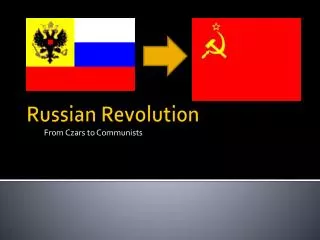
The Big Picture • In the late 1800s Russians rebelled against the absolute power of the czar and demanded social reforms. • Long-term social unrest in Russia exploded in revolution, and ushered in the first communist government. • After Lenin died, Stalin seized power and transformed the Soviet Union into a totalitarian state.
Why We Study This Unit? • The establishment of the first communist government is a major turning point in world history. • Stalin’s totalitarian state would become a model for Mussolini and Hitler. • The Communist Party controlled the Soviet Union until the country’s breakup in 1991.
Essential Questions • Why did the czars follow a cycle of reform and repression? • Why did revolution occur in Russia in March 1917? • Why did Lenin and the Bolsheviks launch the November Revolution?
Essential Questions • How did a Communist state develop under Lenin? • How did Stalin create a totalitarian state? • How did Communism change soviet society?
Unit Overview • Last Unit: WW I • Current Unit: Russian Revolution • Next Unit: WW II
Even Day Learning Activities • 5/8: Unrest in Russia • 5/10: Western vs. Eastern Europe • 5/10: Land of czars notes • 5/14: Rev. 1905 • 5/10: Rev. in Russia Qs • 5/14: Rev. March 1917 • 5/14: Evolution of Communist Thought • 5/16: Bolshevik Rev. • 5/16: Civil War Chart
Even Day • 5/16: Bolshevik Rev. • 5/16: Civil War Chart • 5/16: Lenin’s NEP ppt. • 5/16: From Lenin to Stalin Qs • 5/18: Trotsky vs. Stalin • 5/18: Changes from Lenin to Stalin • 5/18: Life in a Totalitarian State Qs
Even Day • 5/22: Totalitarianism ppt. • 5/22: Traits in the Soviet Union • 5/22: Benefits and Drawbacks • 5/22: Unit Review
ODD Day • 5/11: Unrest in Russia • 5/15: Western vs. Eastern Europe • 5/15: Land of Czars notes • 5/15: Rev. in Russia Qs • 5/15: Rev. 1905 notes • 5/17: Rev. March 1917 • 5/17: Evolution of Communist Thought • 5/21: Bolshevik Rev. • 5/21: Civil War Chart • 5/21: Lenin’s NEP • 5/21: Stalin and Totalitarian State Qs
Odd Day • 5/23: Changes from Lenin to Stalin • 5/23: Totalitarianism ppt. • 5/23: Traits in the Soviet Union • 5/23: Benefits and Drawbacks • 5/23: Unit Review
Applied • 5/10: Unrest in Russia • 5/14: Western vs. Eastern Europe • 5/14: Land of Czars notes • 5/16: Rev. 1905 • 5/16: Rev. in Russia part 1 • 5/18: March 1917 Rev. • 5/18: Evolution of Communist Thought • 5/18: Rev. in Russia part 2
Applied • 5/22: Bolshevik Rev. • 5/22: Civil War Chart • 5/22: Lenin’s NEP • 5/22: From Lenin to Stalin Qs
Terms – Unrest in Russia • Autocracy • Nicholas II • Russo-Japanese War • Socialist Republic • Marx • Lenin • Bloody Sunday • Rev. 1905 • Duma
Terms – Revolution in Russia • Bolsheviks • Rasputin • Trotsky • NEP • Reds • Whites • Bolshevik Revolution • Soviet Union • Five-Year Plan • Collectivization
Life in a Totalitarian State • Totalitarian State • Ideology • Propaganda • Pravda • Atheism • Socialist Realism • Gulags • Great Purge
1. Why did the czars follow a cycle of reform and repression? • In reaction to the Decembrist Revolt, Nicholas I repressed political partiesand ended hope for a constitution and democratic reforms. • Russia’s defeat in the Crimean War pushed Alexander II to reform Russia by freeing the serfs and creating a legislative body to balance power. • Following the assassination of Alexander II, Alexander III repressed the revolutionaries and ended all reforms that posed a threat to his absolute power.
2. Why did revolution occur in Russia in March 1917? • Following the 1905 Revolution, Nicholas II failed to make promised reforms. • WW I placed a strain on the home front, as defeats on the battlefield demonstrated their lack of industrialization. • Finally, Nicholas II was powerless as citizens, soldiers, and the government refused to obey his orders.
3. Why did Lenin and the Bolsheviks launch the November Revolution? • Lenin and the Bolsheviks wanted to overthrow the provisional government. • Their goal was to establish a Communist society based on the ideas of Karl Marx. • They planned to end private property and create social equality. • Lenin promised to end Russia’s participation in WW I, which initially gained him widespread support.
4. How did a Communist state develop under Lenin? • Lenin abolished private property, distributed land to peasants, and granted workers control of the factories. • During the Civil War, War Communism pushed the economy near collapse. • Lenin issued NEP, which allowed capitalist practices such as private ownership of property. • NEP led to economic recovery but was disliked by Communists for its compromise with Capitalism.
5. How did Stalin create a totalitarian state? • Stalin and the Communist party controlled all parts of public and private life. • All economic activity was controlled by the Five Year Plan which pushed industrialization. • Stalin maintained complete control by using the secret police, propaganda, gulags, censorship, and terror.
6. How did Communism change Soviet society? • Under Stalin, Soviet society was dominated by the Communist party. • Benefits included free housing, education, and healthcare for all. • Drawbacks included lack of freedom and rights, low standard of living, and constant fear of Stalin. • The promised equality and control of the country by the workers never existed in Stalin’s totalitarian state.