Understanding Nutrient Absorption and the Digestive System
190 likes | 324 Vues
Our body relies on essential nutrients for energy, growth, and overall health. This article explores the digestive system's role in transforming food into usable nutrients, focusing on carbohydrates, lipids, proteins, water, vitamins, and minerals. It details the four steps of digestion: ingestion, digestion, absorption, and elimination. Furthermore, it highlights the primary and accessory organs involved, including the mouth, esophagus, stomach, small intestine, pancreas, liver, and large intestine. Understanding these processes is key to appreciating how our bodies utilize food for nourishment.


Understanding Nutrient Absorption and the Digestive System
E N D
Presentation Transcript
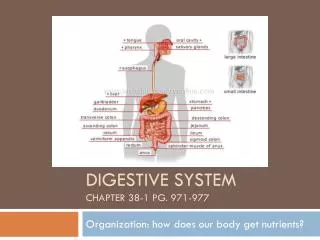
Digestive systemchapter 38-1 pg. 971-977 Organization: how does our body get nutrients?
What nutrients do our bodies need? • Carbohydrates – energy • Lipids – energy, cell membranes, insulation/ protection • Proteins – Many different functions!
What else do our bodies need? • Water – our cells are filled with cytoplasm, which is made of mostly water • Vitamins – Molecules our bodies cant make, but need • Minerals – ions such as iron (Fe2+), Calcium (Ca2+), Sodium (Na+), and Potassium (K+)
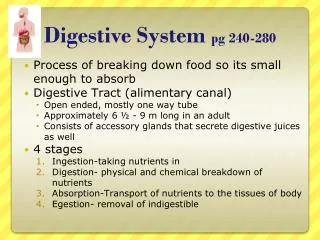
How do we get nutrients? • The function of the digestive system: • Break up complex molecules (food) into smaller pieces that our bodies can use
4 steps to get nutrients • Ingestions – take in food • Digestions – break down food • Absorption – move monomers to blood stream • Elimination – get rid of waste
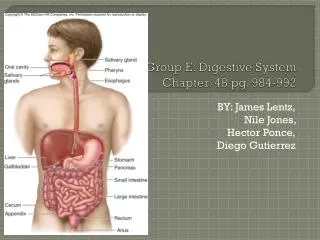
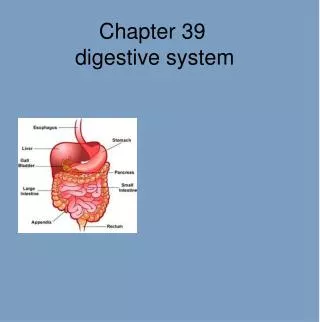
Primary & Accessory Organs • Primary: organs the food passes through • Accessory: food does not pass through, but help in digestion
Mouth • Mechanical digestions: physically breaks apart food • Teeth chew! • Chemical digestion: breaks chemical bonds • Saliva: • contains amylase an enzyme that breaks down polysaccharides • Moistens food
Esophogus • Peristalsis: the contraction of muscles in waves to move and crush the bolus, chewed food. • http://www.youtube.com/watch?v=rJS-Kh5wCQU • Epiglottis: flap that prevents food from going down your trachea (windpipe) when you swallow.
Stomach • Chemical: HCl kills bacteria and activates pepsin enzymes • Pepsin breaks down polypeptides (protein) • Mechanical: muscles crush and mix food into chyme
Small Intestine • Chemical: • Where most digestion takes place • pancreas and liver secrete enzymes into small intestine • Vili: many folds in the walls, which increase surface area for absorption
Pancreas • Accessory organ • Has different types of cells to produce hormones and enzymes • Secretes (produces) enzymes into small intestine: • Amylase – breaks down starch • Trypsin – breaks down polypeptides • Lipase – breaks down triglycerides
Liver • Accessory organ • Connect to the small intestine through the common bile duct • Secretes bile: • Bile emulsifiesfats = bile breaks up clumps of fat
Gall Bladder • Accessory organ • Stores bile
Large Intestine • No digestion • Removes water • Stores waste
More Digestive Enzymes What chemical reaction do these enzymes catalyze ?
Practice Essay • Can you describe what would happen to a slice of pepperoni pizza as it moves through your digestive system? • What macromolecules are in which parts of the pizza? • Where would those macromolecules be digested?