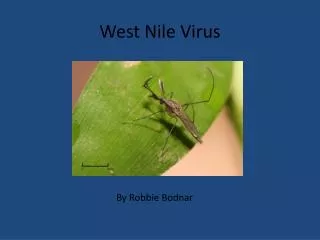
Understanding West Nile Virus: Symptoms, Transmission, and Current Research Insights
West Nile Virus (WNV) is a viral disease that originates from Africa and can be transmitted to humans by infected mosquitoes. Symptoms typically appear within 1-14 days of infection and may include muscle pain, fever, headache, lack of appetite, rash, and nausea. First identified in 1937, WNV emerged in the Western Hemisphere in 1999, particularly in New York City. There is no specific cure, and it can also be transmitted through blood transfusions and from mother to child during pregnancy. Understanding susceptibility is vital, especially among the elderly, who may develop neurological complications.


Understanding West Nile Virus: Symptoms, Transmission, and Current Research Insights
E N D
Presentation Transcript
West Nile Virus Connor Nettles & Catheryn Clifford
Definition • A flu virus of African origin that can be spread to humans via mosquitoes causing encephalitis and flu like symptoms. • Viral disease • 1937
Symptoms • 1-14 days after infected • Muscle pain • Fever • Headache • Lack of apatite • Rash • Nausea
How it Spreads • Infected mosquitoes • Transfusion, transplant, mother to child • Not through touch
Current Research • Emerged in the western hemisphere in the 1999 in New York City • Comes from Africa • No medication to cure • Can be passed during pregnancy
Susceptibility • The elderly can have a neurological disease • Can be genetic
Works Cited • Works Cited • " West Nile Virus, NIAID, NIH." National Institute of Allergy and Infectious Diseases (NIAID). N.p., n.d. Web. 14 Feb. 2013. <http://www.niaid.nih.gov/topics/westnile/Pages/default.aspx>. • "CDC West Nile Virus Homepage." Centers for Disease Control and Prevention. N.p., n.d. Web. 14 Feb. 2013. <http://www.cdc.gov/ncidod/dvbid/westnile/index.htm>. • "CDC: West Nile Virus - What You Need To Know." Centers for Disease Control and Prevention. N.p., n.d. Web. 14 Feb. 2013. <http://www.cdc.gov/ncidod/dvbid/westnile/wnv_factsheet.htm>. • "West Nile virus - PubMed Health." National Center for Biotechnology Information. N.p., n.d. Web. 14 Feb. 2013. <http://www.ncbi.nlm.nih.gov/pubmedhealth/PMH0004457/>.