Download
1 / 5
60 likes | 184 Vues
The West Nile Virus (WNV) emerged in Africa over a thousand years ago and first appeared in the U.S. in 1999, specifically in New York City. It is now found across Africa, Asia, the Middle East, and North America, with limited cases in Europe. Most infections occur during warmer months, primarily transmitted by mosquitoes such as Culex pipiens, Culex tarsalis, and Culex quinquefasciatus. Symptoms in horses include weakness, stumbling, and, in severe cases, paralysis or death. For birds, lethargy may indicate encephalitis. Effective control involves eliminating mosquito breeding sites.

E N D
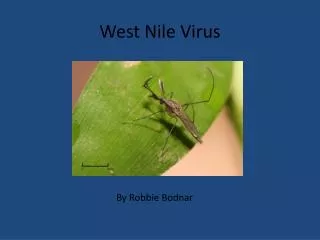
West Nile Virus By Robbie Bodnar
History and Transmission • Emerged in Africa 1000 years ago • Came to the U.S. in 1999 in New York City • Found in Africa, Asia, Middle East, North America, few cases in Europe • Most cases are during the warmer months
Carriers in the U.S. Culex pipiens Culex tarsalis Culex quinquefasciatus
Symptoms Horses: • Listlessness, stumbling around, weakness in limbs, ataxia, partial paralysis, death • Fever not usually observed Birds: • Not necessarily observed until encephalitis • Might appear drowsy, unable to fly and walk
Treatments • Control is mainly by eliminating mosquito breeding sites • INNOVATOR™, Prevenile™, Recombitek™