Download
1 / 16
160 likes | 272 Vues
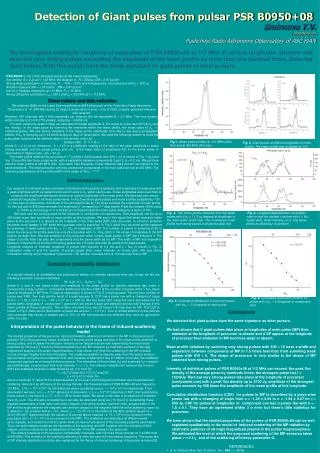
This study presents extensive observations of the pulsar PSR J0653+8051, focusing on the detection of a giant component in its emission profile. Conducted at the Pushchino Radio Astronomy Observatory, the research includes detailed data over multiple sessions from 2012 to 2013. Significant findings involve the identification of burst rates of 0.01% and substantial intensity variations, with factors reaching up to 170 times the mean value. The study also briefly explores the broader implications for understanding pulsar emissions and their temporal dynamics.

E N D
Detection of giant component from pulsar PSR J0653+8051 V.M. Malofeev, D.A. Teplykh, O.I. Malov and S.V. LogvinenkoPushchino Radio Astronomy ObservatoryASC LPI RAS
Observations of B0643+8051 in 1996 Malofeev et al., 1998
Observations LPA: 111.5 ± 1.5 МHz, 3.3 m / cos, Aef 20 000 m2 Digital receiver:512 5 kHz, t =2.45; 5.12 ms Oct.2012 – Oct.2013 255 observation sessions 1 observation session = 994 periods B0643+80(J0653+8051) p = 1,214 s p' = 3,8 10-15 s/s T = 5 106 years B = 2 1012 G DM = 32,5 pc/cm3
Examples of integrated profiles 22.03.2013 S/n < 3 26.5% Intensity in arbitrary units 31.12.2012 3 < S/n < 5 62% 12.12.2012 S/n > 5 12% 1.08.2013 S/n > 10 0,4% Pulse longitude (samples)
Outburst (1.08.2013) Sum of 408 double periods Intensity Frequency Integrated pulse profile Sum of 816 pulses Intensity Pulse longitude (samples)
Outburst (1.08.2013) 158 pulses (C2 – 134) S/n ≥ 2.5 56 pulses (C2 – 56) S/n ≥ 5 16 pulses (C2 – 16) S/n ≥ 10 Intensity Sum of 378 pulses: S/n(C2) < 5 Intensity in arbitrary units Sum of 31 pulses: S/n(C1, C3) > 2,5, S/n(C2) < 5 Sum of 32 pulses: S/n > 5 Pulse longitude (samples) = 80 deg C1 C2 C3
Intensity variations of pulses during session of 1.08.2013 Double period Pulse number Pulse longitude in sample (1 sample = 5,12 ms)
Intensity variations of pulses during session of 1.08.2013 Double period Pulse number Pulse longitude in sample (1 sample = 5,12 ms)
Intensity variations of pulses during session of 1.08.2013 Double period Pulse number Pulse longitude in sample (1 sample = 5,12 ms)
Intensity variations of pulses during session of 1.08.2013 Double period Pulse number Pulse longitude in sample (1 sample = 5,12 ms)
The examples of the individual pulses (1.08.2013) Intensity in arbitrary units Pulse longitude (samples) = 80 deg C1 C2 C3
The dispersion slope in time-frequency plane 16 pulses frequency Time (2 periods)
Nature of events • Mode-switching – NO (very rare event) • Giant pulses – NO (very wide pulses ~ 10 ms) • RRATs(McLaughlin et al., 2006) – POSSIBLE Duration of pulses is 2 – 30 ms and burst rates ranging: 0,4 – 0,01% We have 20 pulses with I/<I> ≥100 (S/n ≥ 10), total number of pulses is 23 ∙ 104 and our bursts rates is 0.01%. If we taken into account pulses with S/n ≥ 5 (I/<I> ≥ 50) the burst rates will be about 0,05%. Bright radio burst of B0656+14 (Weltevrede et al., 2006) has wide emission window ~ 40o, B0643+80 has emission window ~ 5o. • Core emission - ?(Empirical model core-cone emission by J.Rankin) • Giant component - ?
Nature of events • Mode–switching – NO(very rare event) • Giant pulses – NO(very wide pulses ~ 10 ms) • RRATs(McLaughlin at al., 2006) – possible Duration of pulses 2-30 ms and burst rates ranging: 0,4 ÷ 0,01 % We have 20 pulses with (S/n ≥ 10), total number of pulses is 23 ∙104 and our bursts rates is ~ 0,01%. If we taken into account all pulses with S/n ≥ 5 or the burst rates will be about 0,05% Bright radio bursts of B0656+14 (Weltevrede et al., 2006) has wide emission window ~40o , B0643+80 has emission window ~ 5o
Summary • We confirmed the presence of the bursts in second component of three-components profile (Malofeev et al., 1998) • We detected that intensity of this component can be a factor 170 higher than its mean value. The duration of the bursts is about 300 periods (~6 min) and such event is extremely rare ~ 0.01% of observing time • We find the long-time (a few months)variation of intensity of all components, then this value changed in two times withthe average intensity of pulse emission.