Quantum Phases Beyond Single-atom Condensation
10 likes | 128 Vues
This research delves into Bose-Einstein condensation beyond single-atom systems, focusing on the condensation of fermionic atoms through pair formation. The study predicts novel quantum phases in two-boson mixtures, exploring behaviors under attractive and repulsive interactions. Using first-principles quantum many-body theory, the authors examine how these behaviors can be realized in one-dimensional optical lattices. Furthermore, they propose experimental protocols for detecting these phases through advanced momentum correlation spectroscopy, contributing to the understanding of superfluidity and quantum interference.


Quantum Phases Beyond Single-atom Condensation
E N D
Presentation Transcript
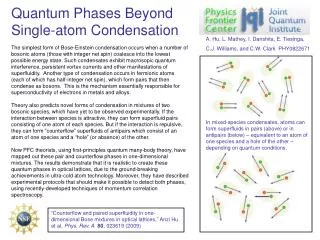
Quantum Phases Beyond Single-atom Condensation A. Hu, L. Mathey, I. Danshita, E. Tiesinga, C.J. Williams, and C.W. Clark PHY0822671 The simplest form of Bose-Einstein condensation occurs when a number of bosonic atoms (those with integer net spin) coalesce into the lowest possible energy state. Such condensates exhibit macrosopic quantum interference, persistent vortex currents and other manifestations of superfluidity. Another type of condensation occurs in fermionic atoms (each of which has half-integer net spin), which form pairs that then condense as bosons. This is the mechanism essentially responsible for superconductivity of electrons in metals and alloys. Theory also predicts novel forms of condensation in mixtures of two bosonic species, which have yet to be observed experimentally. If the interaction between species is attractive, they can form superfluid pairs consisting of one atom of each species. But if the interaction is repulsive, they can form “counterflow” superfluids of antipairs which consist of an atom of one species and a “hole” (or absence) of the other. Now PFC theorists, using first-principles quantum many-body theory, have mapped out these pair and counterflow phases in one-dimensional mixtures. The results demonstrate that it is realistic to create these quantum phases in optical lattices, due to the ground-breaking achievements in ultra-cold atom technology. Moreover, they have described experimental protocols that should make it possible to detect both phases, using recently-developed techniques of momentum correlation spectroscopy. In mixed-species condensates, atoms can form superfluids in pairs (above) or in antipairs (below) – equivalent to an atom of one species and a hole of the other – depending on quantum conditions. “Counterflow and paired superfluidity in one-dimensional Bose mixtures in optical lattices,” Anzi Hu et al, Phys. Rev. A80, 023619 (2009)