Download
1 / 1
10 likes | 111 Vues
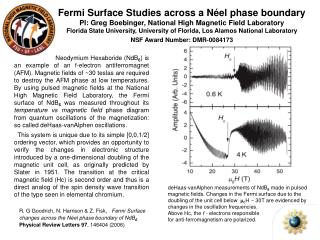
This study examines the Fermi surface of Neodymium Hexaboride (NdB6), an f-electron antiferromagnet, across its Néel phase boundary. Using pulsed magnetic fields at the National High Magnetic Field Laboratory, we measured the Fermi surface via de Haas-van Alphen oscillations, capturing the temperature-magnetic field phase diagram. The approach reveals how a transition at the critical magnetic field impacts electronic structure and Fermi surface characteristics, shedding light on the nature of anti-ferromagnetism and its consequences in NdB6, making it analogous to the spin density wave transition observed in elemental chromium.

E N D
Fermi Surface Studies across a Néel phase boundaryPI: Greg Boebinger, National High Magnetic Field LaboratoryFlorida State University, University of Florida, Los Alamos National Laboratory NSF Award Number: DMR-0084173 Neodymium Hexaboride (NdB6) is an example of an f-electron antiferromagnet (AFM). Magnetic fields of ~30 teslas are required to destroy the AFM phase at low temperatures. By using pulsed magnetic fields at the National High Magnetic Field Laboratory, the Fermi surface of NdB6was measured throughout its temperature vs magnetic field phase diagram from quantum oscillations of the magnetization: so called deHaas-vanAlphen oscillations. This system is unique due to its simple [0,0,1/2] ordering vector, which provides an opportunity to verify the changes in electronic structure introduced by a one-dimensional doubling of the magnetic unit cell, as originally predicted by Slater in 1951. The transition at the critical magnetic field (Hc) is second order and thus is a direct analog of the spin density wave transition of the type seen in elemental chromium. deHaas-vanAlphen measurements of NdB6made in pulsed magnetic fields. Changes in the Fermi surface due to the doubling of the unit cell below m0H ~ 30T are evidenced by changes in the oscillation frequencies. Above Hc, the f - electrons responsible for anti-ferromagnetism are polarized. R. G Goodrich, N. Harrison & Z. Fisk, Fermi Surface changes across the Néel phase boundary of NdB6 Physical Review Letters97, 146404 (2006)