Achieving High-Speed Multiprocessor Systems with Alpha 21364 Architecture
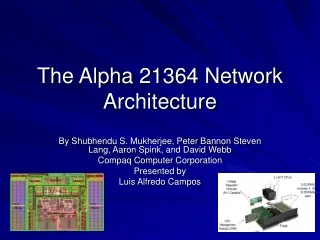
The Alpha 21364 is designed for extremely fast multiprocessor systems and emphasizes high scalability. Key innovations include high-bandwidth, low-latency data access, achieved through on-chip L2 cache and RAMBus memory controllers. This system architecture allows each CPU to directly manage its main memory, mitigating the need for intermediaries. However, it presents significant design and CAD challenges, such as clock skew and redundancy verification. The architecture supports direct inter-CPU communication, using a 2-D torus topology and a sophisticated on-chip routing mechanism.

Achieving High-Speed Multiprocessor Systems with Alpha 21364 Architecture
E N D
Presentation Transcript
Alpha 21364 • Goal: very fast multiprocessor systems, highly scalable • Main trick is high-bandwidth, low-latency data access. • How to do it, how to do it?
Fast access to L2 cache • Easy solution: put it on chip • Technology scaling has made it practical. • Higher bandwidth, lower latency, but smaller size than SRAM. • Many design and CAD problems.
Fast access to main memory • Build a NUMA system. • Each CPU directly controls its main memory chips (no intervening chipset). • On-chip RAMBus memory controller • Multiple frequencies cause design and CAD problems.
Fast remote memory access • Direct communication with other CPUs. • 2-D torus (folded checkerboard) • Switchbox/router on chip for passing packets between any 2 grid points. • Clock-forwarded data via matched T-lines. • Many design and CAD challenges.
All of that, and FAST • Greater than 1 Ghz in initial part. • Faster shrinks to follow. • Many design and CAD challenges!
One-chip scalable system Mem CPU CPU Mem Mem CPU CPU Mem
It gets worse • Much of this has been designed before -- by trial and error. • Now it’s part of a full-custom CPU. • Must be right the first time.
L2 cache • We are combining memory and logic in a high-speed part. • Cache covers a large die area, but is synchronous and needs a clock. • Many conditional clocks are needed to save power. • Problem: how do we control/simulate clock skew?
H tree? • H tree has nominal 0 skew at terminuses. • Real life must include OCV: • L, , sheet , C • Vdd, T • How do we minimize the sensitivity of skew to OCV?
L2 cache logic verification • A cache is not a simple animal. • The “simple” high-level picture is complicated by redundancy, BIST/BISR, fuse farms, optimal repair algorithms, complex circuit design. • Needs verification of RTL and schematics
Too big to verify? • Flat? 4 MB virtual memory / 100M Mos = 40 B/MOS. • The cache is “not quite” hierarchical. • ECC gets in the way (odd # of bits) • mirrored bank pairs share logic • The “same” path may be a race or a critical path in different banks.
Formal verification? • Symbolic simulation of something this big (e.g., with STE) is impossible. • Redundancy is an interesting challenge. • We can verify the pieces: but how do we prove they equal the whole?
The abstraction gap • The model must run fast • The schematics contain 100M devices. • Thus there is an abstraction gap. • This makes formal verification difficult.
Fast access to main memory • Build a NUMA system. • Each CPU directly controls its main memory chips (no intervening chipset). • On-chip RAMBus memory controller • Multiple frequencies cause design and CAD problems.
On-chip Rambus Controller • 400 Mhz dual data rate Rambus • > 1 Ghz CPU • How do they interact?
Fast remote memory access • Direct communication with other CPUs. • 2-D torus (folded checkerboard) • Switchbox/router on chip for passing packets between any 2 grid points. • Clock-forwarded data via matched T-lines. • Many design and CAD challenges.
On Chip Switchbox/router • Message passing usually handled by chipsets. • Now it’s on the CPU • We’ve got to get it right the 1st time.
Routers are tricky • Deadlock, Livelock • Route around broken links • Easy to forget corner cases • Formal verification is a must
High speed CPU • Clocking is a challenge. • Short tick is a challenge. • OCV is a killer. • Power density is also.
Clocking • Wires do not scale (even with copper). • Low clock skew = high clock power. • No longer practical to have a single main clock grid.
Multiple grids • Solution - multiple grids linked by Delay Locked Loops (DLLs). • Use skew-insensitive circuits to cross clock domains. These are functional at any skew (albeit with slower clock frequency). • How do you do static timing verification?
Short tick • “Short tick” CPU is highly pipelined, with small amount of gates between latches. • Most of the design is single-wire clocking, true single phase. • Races are bad.
Double-sided constraints • Tdmax + Tsetup < Tcycle + Ts,min • Tdmin > Thold + Ts,max • Short tick and large delay variation give you a small design window.
OCV • OCV gets worse every generation. • Higher density more T, more V. • Smaller feature size more variability. • Result is more delay variation.
Statistical delay correlation • Many delays are correlated. • Most “nearby” effects move together. • If two clocks have identical layout, they mostly move together. • Howe do we quantify this and use it in timing verification?
Summary • Alpha 21364 is a high-speed CPU targeted at glueless, scalable MP systems. • On-chip L2 cache • On-chip Rambus controllers • On-chip Routing • Many new CAD challenges - not all have solutions identified.