Download
1 / 6
110 likes | 456 Vues
This guide explores the concept of one-to-one functions, defined as functions where no two distinct domain values correspond to the same range value. The function f(x) = x² is a classic example that fails this criterion, as both f(-3) and f(3) yield 9. To determine if a function is one-to-one, we can employ the horizontal line test: if a horizontal line intersects the graph at more than one point, the function is not one-to-one. We illustrate this concept with examples and encourage graphing exercises to reinforce understanding.

E N D
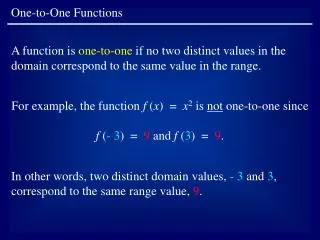
One-to-One Functions A function is one-to-one if no two distinct values in the domain correspond to the same value in the range. For example, the function f (x) = x2 is not one-to-one since f (- 3)=9andf (3)=9. In other words, two distinct domain values, - 3and3,correspond to the same range value, 9.
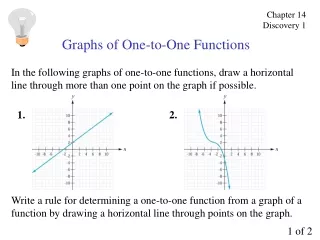
One-to-One Functions There is a horizontal line test associated with the definition. If it there exists a horizontal line that touches the graph of a function in more than one place, the function is not one-to-one. Otherwise, the function is one-to-one.
20 Now look at its graph. 18 16 14 12 10 8 6 4 2 0 -4 -3 -2 -1 1 2 3 4 (- 3, 9) (3, 9) One-to-One Functions To see why the horizontal line test works, look again at the function, f (x) = x2. Earlier, using the definition, it was found not to be one-to-one. You can see that there exists a horizontal line that touches the graph at more than one place, (- 3, 9) and (3, 9). It only takes one horizontal line touching the graph at more than one place to conclude the function is not one-to-one.
Try: Graph and use the horizontal line test to determine whether each function is one-to-one. (a) f (x) = x3 – x – 2. One-to-One Functions It is not one-to-one.
Try: Graph and use the horizontal line test to determine whether each function is one-to-one. (b) f (x) = x3 + x – 2. One-to-One Functions It is one-to-one.
One-to-One Functions END OF PRESENTATION