SlideServe
Menu
Préférences
© SlideServe · v2026

Is the New Madrid Seismic Zone a Dying Fault? Insights from Recent Geological Data

jeremy-pitts avatar
12 diapositives · 248 Views · Nov 18, 2014

Recent data suggests that the New Madrid seismic zone may be becoming inactive after a series of significant earthquakes over the past 1,000 years. Precise GPS measurements indicate minimal ground movement, indicating little strain is building for future large earthquakes similar to those of 1811-12. As seismicity patterns resemble aftershocks from past events, the likelihood of similar large earthquakes occurring in the near future seems low. This analysis integrates geological and geophysical data to highlight the current state and future risk of the New Madrid fault.
Is the New Madrid Seismic Zone a Dying Fault? Insights from Recent Geological Data - slide 1
01 / 12Is the New Madrid Seismic Zone a Dying Fault? Insights from Recent Geological Data
1 / 17

Télécharger la présentation

Is the New Madrid Seismic Zone a Dying Fault? Insights from Recent Geological Data
Une image / un lien ci-dessous est fourni (tel quel) pour télécharger la présentation

Politique de téléchargement : le contenu du site vous est fourni TEL QUEL pour votre information et votre usage personnel ; il ne peut être vendu, concédé sous licence ni partagé sur d’autres sites sans l’accord de son auteur.Le contenu vous est fourni TEL QUEL, pour votre information et votre usage personnel uniquement. Téléchargez la présentation en cliquant sur ce lien. Lors du téléchargement, si vous ne parvenez pas à télécharger une présentation, l’éditeur a peut-être supprimé le fichier de son serveur.Pendant le téléchargement, si vous ne parvenez pas à obtenir une présentation, le fichier a peut-être été supprimé par l’éditeur.

F I N

Plus de contenu associé

Transcription de la présentation
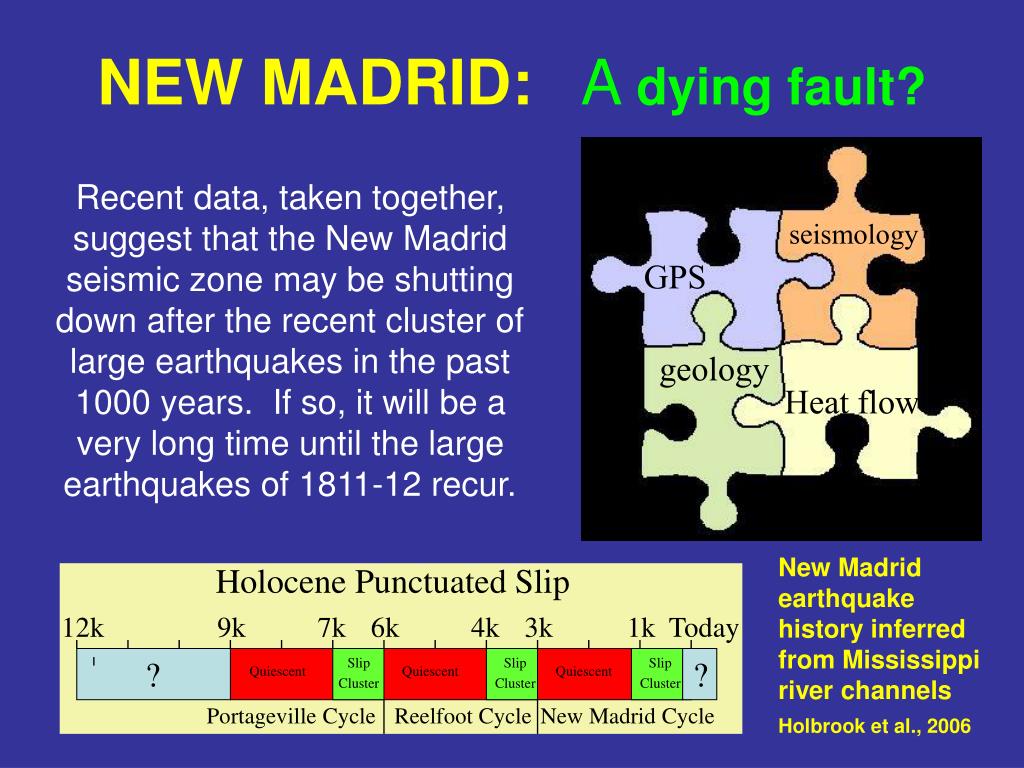
  1. Holocene Punctuated Slip 12k 9k 7k 6k 4k 3k 1k Today ? Slip Cluster Slip Cluster Slip Cluster ? Quiescent Quiescent Quiescent Portageville Cycle Reelfoot Cycle New Madrid Cycle NEW MADRID:A dying fault? Recent data, taken together, suggest that the New Madrid seismic zone may be shutting down after the recent cluster of large earthquakes in the past 1000 years. If so, it will be a very long time until the large earthquakes of 1811-12 recur. seismology GPS geology Heat flow New Madrid earthquake history inferred from Mississippi river channels Holbrook et al., 2006

  2. A DYING FAULT?In the past 15 years we’ve learned: Precise GPS measurements show that the ground is barely moving or isn’t moving, so little or no strain is building up for a future earthquakeThe small earthquakes we see today look like aftershocks of the large 1811-12 earthquakesThe New Madrid zone doesn’t look thermally or mechanically different from many other structures in the central U.S.Geological data show that the New Madrid zone goes through pulses of activityThe simplest explanation is that the present pulse is ending

  3. GPS SITES SHOW LITTLE OR NO MOTION Stein 2007 Thus a very long time would be needed to store up the slip needed for a future large earthquake For steady motion, M 7 is at least hundreds of years away. M 8 would thousands. Motions with respect to the rigid North American plate are small, < 2 mm/yr , and generally within their error ellipses. The data do not require motion, and restrict any motion to being very slow.

  4. NEW MADRID SEISMICITY: 1811-12 AFTERSHOCKS? Stein & Newman, 1994 Ongoing seismicity looks like aftershocks of 1811-12, as suggested by the fact that the rate & size are decreasing. Moreover, the largest are at the ends of the presumed 1811-12 ruptures Looks like a dying fault?

  5. ROCK MECHANICS CONSISTENT WITH LONG INTRAPLATE AFTERSHOCK SEQUENCES Dieterich (1994) model relates ratio of aftershock length to main shock recurrence ta/ tr  1/stressing rate For low intraplate stressing rate, could have 200 year aftershocks for 500 yr recurrence Hence large 1811-12 style events may not recur here for a very long time, but could migrate elsewhere. INTERPLATE EARTHQUAKES Stein & Newman, 1994

  6. Holocene Punctuated Slip 12k 9k 7k 6k 4k 3k 1k Today ? Slip Cluster Slip Cluster Slip Cluster ? Quiescent Quiescent Quiescent Portageville Cycle Reelfoot Cycle New Madrid Cycle GEOLOGY IMPLIES NEW MADRID EARTHQUAKES ARE EPISODIC & CLUSTERED The absence of significant fault topography, and other geological data, imply that the recent pulse of activity is only a few thousand years old. This is consistent with results from other continental interiors showing episodic & clustered earthquakes New Madrid earthquake history inferred from Mississippi river channels Holbrook et al., 2006

  7. Why are NMSZ earthquakes concentrated on the Reelfoot Rift, when the continent contains many fossil structures that seem equally likely candidates for concentrated seismicity? Liu & Zoback (1997)suggest the NMSZ is hotter and thus weaker than surrounding regions, so the weak lower crust and mantle concentrate stress and seismicity here in the upper crust. Alternatively, if the NMSZ is not significantly hotter and weaker than its surroundings, seismicity is likely to be episodic and migrate among many similar fossil weak zones. NEW MADRID SEISMICITY: EPISODIC & MIGRATING? M. Liu o Historicalo Instrumental

  8. IS NMSZ HOT & WEAK? Liu & Zoback (1997) argue that NMSZ heat flow ~ 15 mW/m2 higher than the surrounding area, so crust and upper mantle are significantly hotter and thus weaker than surroundings.

  9. NMSZ heat flow, 55+/-7 mW/m2, at most slightly higher than mean eastern U.S. heat flow of 52 +/-22 mW/m2 Anomaly is either absent or much smaller (3+/-23 rather than 15 mW/m2) than assumed

  10. The resulting geotherms predict that temperature differences between the NMSZ and the average CEUS are trivial in the seismogenic crust, and small in the mantle, rather than the large differences predicted by Liu & Zoback (1997) LZ are geotherms plotted in Liu & Zoback (1997), LZC denote geotherms computed from Liu & Zoback (1997) values. MSS denotes geotherms for our models. BDS is basalt dry solidus.

  11. NMSZ IS NOT HOT & WEAK For our model of a much smaller temperature contrast, the NMSZ and CEUS have essentially the same strength. Hence there would be no tendency for upper crustal stresses to be concentrated in the NMSZ.

  12. GPS, seismological, geologic, & geothermal data are consistent with the NMSZ shutting down after the recent cluster of large events The longer geodetic data show essentially no motion, the more likely it seems that the fault is shutting down Seismicity may migrate to somewhere else Hazard from 1811-12 style large events may be small for thousands of years In this case, the seismic hazard from large 1811-12 style events should be viewed as lower and diffuse rather than high and concentrated near the 1811-12 rupture.