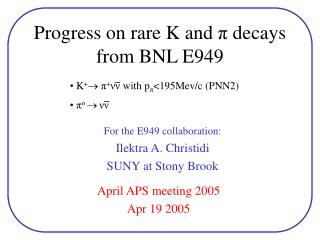
Progress on Rare K and π Decays: BNL E949 Findings and Future Directions
210 likes | 333 Vues
This report presents updates from the E949 collaboration at the April APS meeting (2005), focusing on the rare decays K+ → π+νν and π0 → νν. These decays are critical for defining the Unitarity triangle and testing the Standard Model of particle physics. The presentation highlights the innovative experimental techniques employed, including the usage of a slowed-down K+ beam and advanced detection mechanisms. Improved background suppression strategies and future work in PNN2 analysis are also discussed, with implications for new physics and precision measurements of CKM matrix elements.


Progress on Rare K and π Decays: BNL E949 Findings and Future Directions
E N D
Presentation Transcript
Progress on rare K and π decays from BNL E949 • K+ π+νν with pπ<195Mev/c (PNN2) • πo νν For the E949 collaboration: Ilektra A. Christidi SUNY at Stony Brook April APS meeting 2005 Apr 19 2005
Goal: Independently define the Unitarity triangle/ CKM matrix (A, λ, η, ρ Wolfenstein parameters) Vud Vub* + Vcd Vcb* + Vtd Vtb* = 0 Theory-motivation A better determination of Vtd from K+π+νν will provide a sensitive test of the SM by comparing the results from the K and B sector and probe new physics Rare K & π decays from E949 Ilektra A. Christidi
Neutral Flavor Changing Process all diagrams 2nd order • Main contribution of t in the loop • Very theoretically “clean” calculation (precision < 5%, uncertainties mainly from c sector) The SM K+π+νν BR ellipse in ρ-η plane Rare K & π decays from E949 Ilektra A. Christidi
“PNN1” “PNN2” Current situation Rare K & π decays from E949 Ilektra A. Christidi
Incoming 700MeV/c beam K slowed down by BeO and AD • K+ stops & decays at rest in scintillating fiber target – measure delay (2ns) • Outgoing π+ momentum measured in UTC, energy & range in RS and target The measurement w/ E949 detector • π+stops & decays in RS – detect π+μ+e+ chain • Photons vetoed hermetically in BV-BVL, RS, EC, CO, USPV, DSPV Rare K & π decays from E949 Ilektra A. Christidi
Incoming 700MeV/c beam K slowed down by BeO and AD • K+ stops & decays at rest in scintillating fiber target – measure delay (2ns) • Outgoing π+ momentum measured in UTC, energy & range in RS and target • π+stops & decays in RS – detect π+μ+e+ chain • Photons vetoed hermetically in BV-BVL, RS, EC, CO, USPV, DSPV • New/upgraded elements The measurement w/ E949 detector Rare K & π decays from E949 Ilektra A. Christidi
“PNN1” PNN2 “PNN2” • 3-body decay w/ 2 missing particles: 0 pπ+ 227 MeV/c • Signal: π+ + nothing , backgrounds (bg) vetoed ~ 10-11 ! • Need • particle identification (PID) • all other charged particles vetoed < 10-3 • redundant precise kinematic measurements Backgrounds Rare K & π decays from E949 Ilektra A. Christidi
Main bg mechanism: K+π+ποwith π+scatter in target • Simultaneous shift in range AND momentum • Photons head near beam direction, the weakest PV region of the detector • Goal: sensitivity equal to PNN1, s/b = 1 • 2 acceptance and 5 rejection • Improved PV: new detectors at central region (BVL) and small angles • Improved algorithms to identify π+scatters in target PNN2 analysis Rare K & π decays from E949 Ilektra A. Christidi
In the Kπ2 kinematic box: • ~ 2 better rejection at nominal PNN1 acceptance (80%) or • ~ 5% more acceptance with E787 rejection ! • Good news for PNN2 as well… Extra tools for PNN2: • Active degrader (PV detector near beam) • Account for “veto blindness” (i.e. when an early accidental masks the γ pulse, by using double-pulse information and early-time loose veto. E787, E949 Photon Veto improvement Rare K & π decays from E949 Ilektra A. Christidi
πo νν analysis by K.Mizouchi, Kyoto University, Japan
Theoretical motivation • Decay prohibited by helicity for massless ν • For massive ν, • therefore, for the max mντ= 18.2 MeV/c, BR < 2.110-9 • From cosmology: cooling through the pion pole γγπονν gives BR < 2.910-13 , but it’s model dependent • Existing limits: BR < 8.310-7 (90% CL) from E787 • Inclusive measurement: πο anything invisible BSM Rare K & π decays from E949 Ilektra A. Christidi
Tag ποfrom Kπ2(K+→π+πo)decay pπo =pπ+= 205MeV/c • Signal: π+ + nothing , but with fixed 2-body kinematics • Two steps in selection/bg calculation: • Kπ2tag, non-Kπ2bg calculated from data w/ blind analysis: 3.07 events • Apply tightest PV & look in the box. Conservative limit: all events due to missed photons from detector inefficiencies. Poisson 90% CL Correction factors Background & measurement # of Kaons Kπ2acceptance Rare K & π decays from E949 Ilektra A. Christidi
PV cuts tuned on 1/3 of the sample, randomly selected, with optimization procedure. • 1/3 sample discarded, to maintain blindness, and measurement is done with the remaining 2/3. • Open the 2/3 sample box: 99 events 99 - 3.07 = 95.93 good Kπ2tags N90 = 110 • NK = 3.019109 • AKπ2 = 0.1173 • CdisCacc = 1.136 • So, Analysis & result Rare K & π decays from E949 Ilektra A. Christidi
E787 upgrade into E949 worked as expected: x2 better PV rejection at PNN1 acceptance, x10 at low acceptances • PNN2 analysis under way, showing signs of improved bg suppression • Updated pi0->nunu BR limit, x3 better than before: 2.73x10⁻⁷ from 8.3 Conclusions Rare K & π decays from E949 Ilektra A. Christidi
Rare K & π decays from E949 Ilektra A. Christidi Candidate E787A Candidate E787C Previous (E787) results (2)
Rare K & π decays from E949 Ilektra A. Christidi stuff
Rare K & π decays from E949 Ilektra A. Christidi Delayed coincidence
Rare K & π decays from E949 Ilektra A. Christidi Eμ = 4.1 MeV, Rμ ~ 1 mm, τπ =26 ns Ee < 53 MeV, τμ = 2.2 μs π+ μ+ e+ identification
Rare K & π decays from E949 Ilektra A. Christidi BR dependence on s/b of cell where event is found: Toy MC for Junk code