Exploring the Mysteries of Uranus: Discoveries and Unique Characteristics
300 likes | 426 Vues
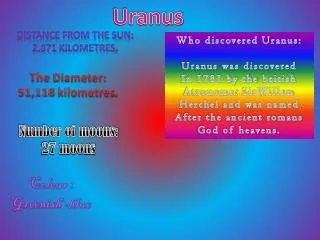
Uranus, discovered accidentally by William Herschel in March 1781, has fascinated astronomers with its peculiar traits. It was visited by Voyager 2 in 1986, revealing an atmosphere that appears bland due to a lack of internal heat. This gas giant, composed mainly of hydrogen and helium, features a striking bluish color due to methane. Intriguingly, its magnetic field is misaligned and tilted, and each pole experiences 42 years of continuous sunlight followed by 42 years of darkness. Its complex ring system and interaction with its moons like Cordelia and Ophelia add to Uranus' enigmatic status in our solar system.


Exploring the Mysteries of Uranus: Discoveries and Unique Characteristics
E N D
Presentation Transcript
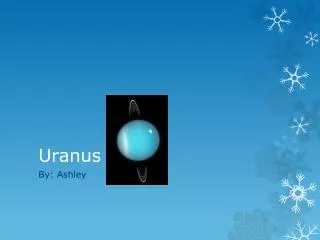
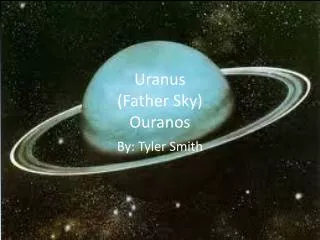
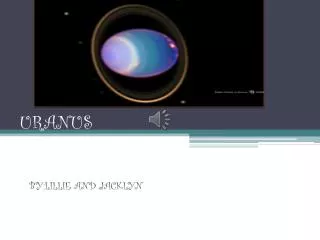
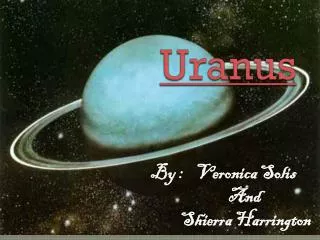
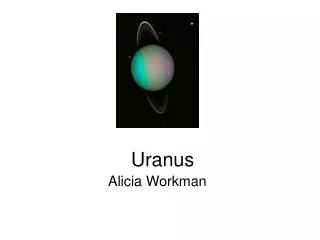
Uranus As seen by Voyager
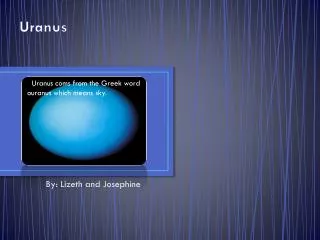
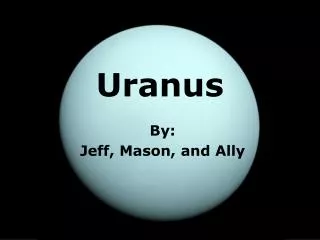
Uranus Highlights • Accidently discovered in March 1781 by William Herschel • Fits Bode’s Law! • Visited by Voyager 2 in 1986 • Suspicious lack of internal heat – probably leads to bland appearance of atmosphere • Composition: ~75% H, ~25% he • Probably a small rocky core (3% of total mass) • Ice-rock “slush” interior • Bluish color derives from methane which is a good absorber of red light
Discovery of Uranus William Herschel at left discovered Uranus by accident. He used the 6-inch telescope at right, which he built himself.
Oddball Properties of Uranus • Magnetic field: • About same Earth’s field • BUT, dipole inclined by 60o and offset from planet center by 1/3 of RU Caught during a field reversal??? • Tilt: • Extreme tilt remains unexplained • Each pole spends 42 years in light and then 42 in darkness
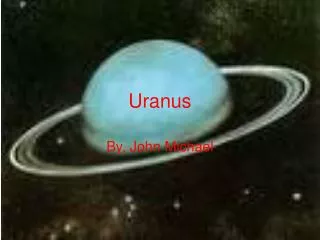
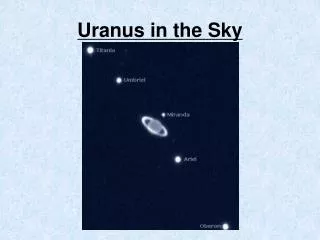
Rings of Uranus • Discovered March 1977 during a stellar occultation • Nine narrow rings ranging in width 10-100 km • Thin and faint with particles of size cm to several meters • Dust fills inter-ring gaps • Requires replenishment • Moons Cordelia and Ophelia act to shepherd some rings
Share Question Seasons on Uranus are a) as long as Uranus' year b) non-existent c) one fourth of Uranus' year, or about 20 Earth years long d) four times Uranus' year, or about 320 Earth years long
Discovery of Neptune • By 1821, the orbit of Uranus clearly deviated from its predicted path which couldn’t be explained by influence of known planets. • Evidence for another planet! • “Discovered” by Adams (English, late 1845) and Leverrier (France, 1846) independently • 1st observed by Galle (German) on 9/23/1846
Neptune’s Atmosphere • Belts • Zones • Clouds • Wind - 2200kph at the equator • Storms - ovals and Great Dark Spot • Great Dark Spot: • High pressure region in S. hemisphere, about size of Earth • By 1994, Spot had disappeared, and a new Dark Spot had formed at N. latitudes (HST)
Neptune’s Magnetic Field • Surface field similar to Earth’s in strength • Magnetic axis tilted by 47o • Dipole offset by 1/2 RN Unlikely that both Uranus and Neptune are undergoing field reversals at the same time!
Internal Energy of Neptune • Uranus lacks convection and therefore storms • Neptune does have internal heat like Jupiter and Saturn (Neptune emits 60% more than absorbs) • A MYSTERY! How can Uranus and Neptune be so different when so similar in size and mass? [Inhibition of convection in Uranus?]
Rings of Neptune Voyager 2 found rings, although there had been previous evidence for them • Dark and faint • Little intergap dust • Rings likely composed of dust themselves • Bright arcs in out ring (effect of shepherding?)