Understanding Stressors in Work Performance: Impact on Cognitive Processing and Workload
This document explores the relationship between experience, environmental stressors, and physiological arousal in demanding work situations. Psychological stressors such as fear, embarrassment, and loss of esteem contribute to perceptual narrowing, memory loss, and strategic errors, influenced by personal traits and life stressors. The Yerkes-Dodson law describes how varying arousal levels affect performance and workload. It also discusses measurement techniques for workload, including task analysis, subjective assessments, and the impact of sleep loss on performance. The emphasis is on understanding how to alleviate stress for better efficiency and safety.

Understanding Stressors in Work Performance: Impact on Cognitive Processing and Workload
E N D
Presentation Transcript
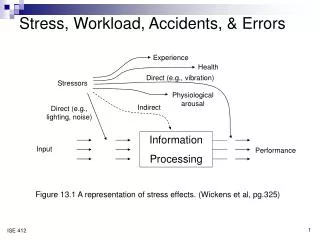
Experience Health Direct (e.g., vibration) Stressors Physiological arousal Indirect Direct (e.g., lighting, noise) Information Processing Input Performance Stress, Workload, Accidents, & Errors Figure 13.1 A representation of stress effects. (Wickens et al, pg.325)
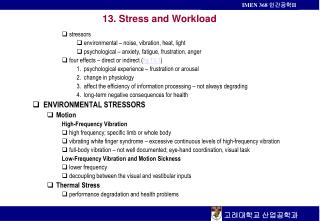
Psychological Stressors • Fear, embarrassment, loss of esteem, etc. • Effects • Perceptual / attention narrowing or tunneling cognitive tunnel vision • working memory loss • strategic shifts, e.g., tendency to react too quickly • Effect depends on individual factors – • personality traits • level of experience • life stress - and on level of physiological arousal induced by the stressor. • Yerkes-Dobson law
Workload and Performance • Yerkes-Dobson law Low arousal ________________ Moderate arousal ____________ Overarousal _______________
Workload Measures • Time required / Time available (TR/TA) ratio • Based on task analysis • Percentage computed per time unit on task timeline • Useful predictor, but difficult to construct • Primary task measures • measure the influence of mental workload • Secondary task methods • measure the reserve capacity • Physiological measures • allow non-intrusive measures • Subjective measures • SWAT, TLX, etc. FUNCTIONAL MENTAL
An example using NASA TLX • Form two teams. Each team will follow the instructions given to you. • You have 1 minute to complete the task. • The team that comes closest to completing their task with the fewest errors will “win.”
Relative workload scores: • Enter your workload scores below: • What does this say about the relative workload of the two tasks? • What does this say about the subjective nature of the workload scores?
Sleep loss and desynchronization • Fatigue effects on performance • accident rates directly due to fatigue • performance on exams • effect on medical treatment, decision making, etc. • See figure 13.6, pg. 346 • Causes • deprivation • disruption • phase in circadian rhythms • desynchronization – shiftwork strategies • Remediation • get more sleep! • napping • sleep credits • sleep management
Your turn … • On the following pages you will find a checklist of variables that increase the effort demanded by a task. For each of the variables: • define the specific effect in your own word • identify relevant theories, experimental results, or principles from what we have learned so far this term • provide an example of good design • provide an example of bad design • Use the table on the following pages. The first row is filled in as an example.