Download
1 / 16
160 likes | 268 Vues
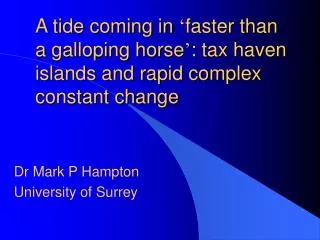
Dr. Mark P. Hampton from the University of Surrey explores the concept of Rapid Complex Constant Change (RC3) and its significance for tax haven islands. The presentation examines the offshore finance landscape, highlighting that 70 tax havens collectively hold $11 trillion, which constitutes 25% of the world's money supply. It analyzes the implications of international regulatory pressures led by entities like the OECD and the FATF, alongside insights into the evolving relationship between island economies and the dominant offshore finance industry.

E N D
A tide coming in ‘faster than a galloping horse’: tax haven islands and rapid complex constant change Dr Mark P Hampton University of Surrey
Presentation Outline • RC3 and tax haven islands • Why is RC3 significant for islands?
RC3 and tax haven islands Scale of offshore & tax havens: • 70 tax havens holding $11 trillion • 25% world money supply offshore • 50% gross value world trade via tax havens • Most tax havens in small islands • Offshore finance since early 20th century
BUT • Since late 1990s unprecedented sequence of international initiatives: • OECD; IMF; G7's FATF & FSF; EU; UN; national governments • RC3 (Rapid Complex Constant Change)
'Four spaces' (Hampton, 1996b) as organising framework for RC3 • Regulatory space • Fiscal space • Secrecy space • Political space
The Four Spaces and RC3 Regulatory space: • G7's FSF 2000 rankings • IMF inspections • UK official reports (Edwards, 1998 & KPMG, 2000)
The Four Spaces and RC3 Fiscal space: • OECD harmful tax competition 1998 • Irish Revenue success • EU information exchange & withholding taxes
The Four Spaces and RC3 Secrecy space (money laundering): • G7’s FATF (post 9/11 re-energised) • UN Program against Money Laundering Political space
Why is RC3 significant for island tax havens? • Cost of new regulation & enforcement • Lack of personnel & structures • Overloads island government systems • Creates uncertainty & pressure on decision-making • Is the impact of RC3 a function of smallness of islands?
Why is RC3 significant for island tax havens? • Links to dominant industry & capture of state by OFC? • Exacerbated - islands believe own PR? • Different narratives: official narrative how islands are in control of ‘their’ OFC Vs. • Reality of dominant tax haven industry & its global agenda
Conclusions • For tax haven islands - how to cope with RC3 (or manage) external shocks? • Trends? • Binary - Functional OFCs & Notional OFCs: • Functional OFCs - complain but comply • Notional OFCs - ignore & risk it
Conclusions • Football (soccer) analogy: Premiership clubs vs. Saturday morning amateur league!
And Finally: • Growing civil society response to tax havens • Changing perceptions from broad tolerance to active campaigning against tax havens (Tax Justice Network, AABA, Attac) • Are the ‘golden years’ over for tax haven islands?
"What would we do instead? If the OECD closed us down, we would become depopulated and derelict." John Cashen, Chief Finance Officer, Isle of Man
"Offshore exists but they see it as a bad thing. If the OECD stopped imposing penal taxes on their own citizens, we wouldn't exist. That's all they need to do. They'd solve the problem. They're so-called capitalist countries imposing socialist rates of tax on their own citizens. It's more or less a human rights issue really." Isaac Legair, Director Financial Supervision Unit, St Lucia
Thank you Dr Mark P Hampton University of Surrey mark.hampton@surrey.ac.uk