Strategies for Fragmentation and Query Optimization in Distributed Databases
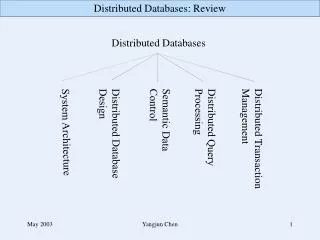
This review outlines various techniques for partitioning relations within distributed databases, focusing on fragmentation types such as primary horizontal, derived horizontal, vertical, and hybrid methods. Key principles include completeness (ensuring no tuples are lost), disjointness (avoiding duplicate tuples), and reconstruction of the original relation. Additionally, it discusses minterm-based horizontal fragmentation, vertical splitting by attributes, and the optimization of query processing through effective join strategies and cost-based algorithms. The goal is to enhance performance while maintaining data integrity.

Strategies for Fragmentation and Query Optimization in Distributed Databases
E N D
Presentation Transcript
Distributed DatabasesReview CS347 June 6, 2001
Fragmentation • How to partition relation into various pieces/fragments • Types: • Primary Horizontal • Derived Horizontal • Vertical • Hybrid of the above possible • Desiderata • Completeness: don’t lose tuples • Disjointness: no duplicate tuples • Reconstruction: make sure you can get back original relation
Minterm-based horizontal frag. • Simple predicates Pr = {p1, p2,.., pm} and R. • Generate “minterm” predicates from Pr • Eliminate and simplify (depends on app semantics) • Generate fragment m(R) for each minterm “m”. • Simple predicates: • Pr must be complete (do not under fragment) and minimal (do not over fragment) • Use predicates occurring in most frequent queries
Derived Horizontal • R fragmented into {R1, R2, …, Rn} • For S, derive {S1, S2, …, Sn}where Si =S Ri • Useful for join queries between R and S • For completeness: referential integrity constraint S R • For disjointness: join attribute is key of R Vertical Split R by attributes Repeat key attribute in each vertical fragment Attribute affinities define grouping
A A i Localization • Convert query tree on relations into query tree on fragments • Simplify ( up & , down) • Rules • [R: False] Ø • C1[R: C2] [R: C1 C2] • [R: C1] [S: C2] [R S: C1 C2 R.A = S.A] • Give vertical fragments Ri = Ai(R), for any B A: B (R) = B [ Ri | B Ai Ø]
Distributed Operators • Sort • Basic sort (sort each individual fragment) • Range partitioning sort (partition by sort attribute + basic sort) • Parallel external sort merge (local sort + range partition by sort attribute) • Key issue: selecting partitioning vector • Join • Partitioned join (only for equi-joins) • Asymmetric fragment+replicate join (fragment R, replicate S) • General fragment+replicate join (fragment and replicate R and S, join all possible pairs) • Semi join programs (to reduce communication cost)
Query Optimization • Exhaustive + pruning • Enumerate all possible QEP’s with given set of operators • Prune using heuristics (e.g., avoid cartesian products) • Choose minimum cost QEP • Hill climbing • Initial feasible QEP + set of QEP transformations • Iterate until no more cost reduction • Transform current QEP all possible ways • Check cost of each transformed QEP • Choose minimum and set as current QEP