The Scientific Revolution: Transforming Knowledge in 1500-1750
90 likes | 249 Vues
The Scientific Revolution (1500-1750) marked a profound shift from medieval scientific philosophy to a new framework emphasizing experimentation and the scientific method. Key thinkers like Copernicus, Galileo, and Newton reframed our understanding of the cosmos and physical laws. Collaboration with mathematical and astronomical communities validated science as an independent discipline. The British Royal Society emerged as a pivotal institution for scientific publication, reflecting the era's commitment to empirical observation. This transformation reshaped perceptions of divinity and humanity’s dominion over nature, fostering a mechanistic view of the universe.


The Scientific Revolution: Transforming Knowledge in 1500-1750
E N D
Presentation Transcript
Changes medieval scientific philosophy abandoned in favor of new methods the importance of experimentation to the scientific method reaffirmed the importance of God to science invalidated pursuit of science itself (rather than philosophy) gained validity on its own terms
Abandoning Medievalism collaboration with mathematical & astronomical communities inadequacy of medieval experimental methods access to legacy of European, Greek, and Middle Eastern scientific philosophy British Royal Society helped validate science providing an outlet for publication
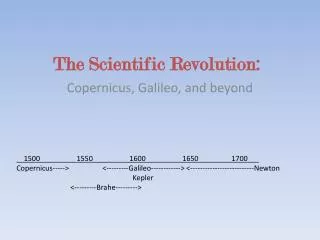
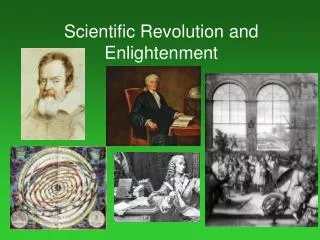
Scientific Developments Nicolaus Copernicus : heliocentric theory of cosmology Galileo Galilei: laws for falling bodies William Harvey: blood circulates Johannes Kepler: laws of planetary motion Antony van Leeuwenhoek: single lens microscopes Isaac Newton: elliptical orbits of the planets & law of universal gravitation
Particular view of the nature of reality Science can account for only those aspects of nature that are accessible to scientific methods of observation and explanation
Insistence on exact observation No explanation of a fact or event in nature has been acceptable unless it has taken into account all of the observed data
Universe a vast machine operating according to mathematical laws the vast universe came more and more to be seen and felt as a collection of physical bodies moving through space according to immutable mathematical laws
Conceptions of divinity changed no longer saw the necessity of postulating the presence of a deity to explain the workings of the universe
Conclusion increasing control of physical forces master nature for own purposes