Open-Source Remote Monitoring System for Solar Power: A Cost-Effective Solution
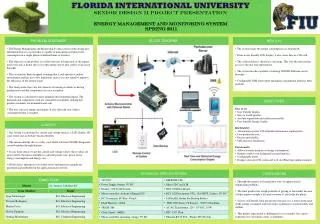
This presentation outlines the development of an open-source remote monitoring system designed for solar power systems. It comprises hardware that interfaces with charge controllers to transmit data and software that stores and analyzes this data. The aim is to provide an affordable and flexible solution, overcoming the limitations of expensive proprietary products while empowering individuals in decentralized power generation. Key requirements include minimal customization and extensibility, using accessible components like Arduino and inexpensive cell phones. Additional documentation and ongoing progress details are available online.

Open-Source Remote Monitoring System for Solar Power: A Cost-Effective Solution
E N D
Presentation Transcript
Senior Project: Presentation 1 An Open-Source Remote Monitoring System Nikolas Wolfe CEN 4914 October 6, 2009
What? • An open-source monitoring system for remote solar power systems • Two Parts: 1.) Hardware Component: Interfaces with charge controller, transmits data 2.) Software Component: Stores and analyzes data
Why? • Existing products are expensive, limited, and proprietary • RM is an important aspect of decentralized power generation • Individuals should be able to take their own initiatives
Inspiration? Why doesn’t this work? Sanyang, The Gambia, Summer 2007
Requirements? • No Customized Hardware • All Open-Source Software • Extensible and Reproducible • Minimizes After-Installation Costs
Implementation, Part 1 What is the simplest, least expensive way to accomplish this? Arduino Duemilanove: $30 disposable cell phone: $15
Implementation, Part 2 Phone dials DTMF tones… Putting the pieces together…. DTMF transmitted over connected line… Arduino enables buffers…
Highlights… • Not a replacement for maintenance of solar power systems! • Working with Advanced Solar Technologies , Inc. (http://ast-solar.com/) on requirements, testing • Further documentation online at http://code.google.com/p/solar-monitoring-project/
Conclusion… • Realistic expectation is for working prototype • Progress slow but steady…