Tips for Writing a Successful IRB Application: A Comprehensive Guide
This guide, presented by Karen Adams, Regulatory Specialist at ITHS, provides essential tips for writing a successful Institutional Review Board (IRB) application. It covers goals, background, study procedures, subject population, recruitment strategies, consent processes, risks, benefits, and confidentiality. Key advice includes using clear language, knowing institutional rules, being thorough, and engaging with IRB administrators. Mastering these elements will enhance your application's chances of approval by presenting a coherent and well-structured proposal.

Tips for Writing a Successful IRB Application: A Comprehensive Guide
E N D
Presentation Transcript
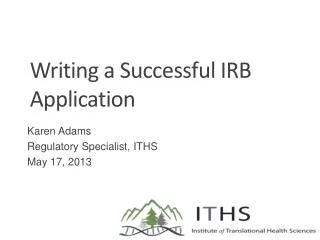
Writing a Successful IRB Application Karen Adams Regulatory Specialist, ITHS May 17, 2013
Goals for today • General tips • Background/purpose • Study procedures • Subject population • Recruitment • Consent process • Risks • Benefits • Confidentiality
Quick tips • Ascertain level of IRB review • Know the rules that apply to the study • Follow institutional instructions • Use current forms and template from the IRB site • Write with clear, simple lay language • Use active voice • Write from scratch • Be complete. Don’t leave anything out. • Include attachments. • Leverage your resources • Proofread carefully
The purpose of this study is… • Include sufficient background information • State the objectives of the research • Include the rationale for the study
Questions to consider: 1. 2. 3.
Study procedures (1) Accurately describe the study design (2) List complete description of research activities • Include primary and secondary data collection • Research procedures and not standard of care • Use a visual outline of the procedures • Format! (bullet points, numbering) • Include brief data analysis procedure • Attach data collection tools • Attach the study protocol
Questions to consider: 1. 2. 3. 4.
Subject population • Explain the characteristics of the population to be studied • List and define the inclusion/exclusion criteria • List the maximum number of subjects
Questions to consider: 1. 2. 3.
Recruitment: who, how, when, what? • Describe every recruitment method • Check for institutional policies • Avoid “cold calls” • Give details! • Explain the privacy of the setting • Attach direct ads, scripts, dear doctor letters, etc.
Questions to consider: 1. 2. 3. 4. 5.
Consent as a process • Explain how consent will be obtained • Written informed consent is standard • Give details! • Explain the privacy of the setting • Attach consent documents
Questions to consider: 1. 2. 3. 4. 5.
Discussion of risks • Show awareness of the risks involved • Only include risks related to the research • Explain the likelihood of these risks occurring (e.g., likely, less likely, rare) • Point to published literature • Use bullet points, or outline the risks in a table or grid • Explain how each risk will be minimized • Minimal risk? • Risks still exist!
Questions to consider: 1. 2. 3. 4.
Benefits • Explain individual benefits vs. benefits to society • Assess benefits accurately • Only include benefits related to the research • Remuneration is not a study benefit
Questions to consider: 1. 2. 3.
Confidentiality procedures • Convey how you will maintain the confidentiality of research data • Confidentiality protections are relative • Use the gold standard and code! • State how long you will keep data linked to identifiers (DD/MM/YYYY) • Follow institutional policies on storage and security
Questions to consider: 1. 2. 3. 4. 5.
Market your IRB application • Presentation is essential • Talk with the IRB Administrators/Analysts • Be available • Curb frustrations • The power of “Thank you”