Price Discrimination
This overview by COL Gutermuth explores price discrimination as a strategy to enhance profits in industrial organization. It identifies the necessary conditions for effective price discrimination, including market power, consumer demand knowledge, and prevention of resale. The types of discrimination discussed include first, second, and third degree, each with unique pricing strategies. The document also outlines the steps to solve market segmentation problems, providing a systematic approach to profit maximization. Learn how different pricing strategies can influence revenue and market dynamics.

Price Discrimination
E N D
Presentation Transcript
Price Discrimination … nonuniform pricing … COL Gutermuth - Industrial Organization
… to increase profits • MR = sum of 2 effects • (1) in revenues from selling one more unit at price p • (2) in revenues on all exiting output • =Qp where p=fall in price needed to sell one more unit • All price discrimination attempts to reduce the second effect above! COL Gutermuth - Industrial Organization
Necessary Conditions • Market Power • Knowledge of Consumers’ Demand • Prevention of Resale • Services • Warranties • Adulteration • High Transaction Costs • Contractual Remedies • Vertical Integration COL Gutermuth - Industrial Organization
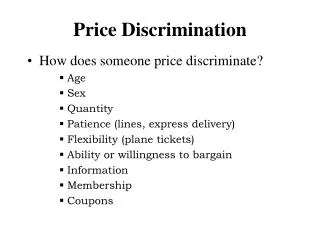
Types of Discrimination • First Degree • Each consumer charged his/her marginal value • No DWL • Second Degree • Multi-Part Pricing • Quantity Discount • Declining Block Schedule • Third Degree • Market Segmentation COL Gutermuth - Industrial Organization
How to Solve Market Segmentation Problems Given: Demand Curve1 Demand Curve2 Firm’s Cost Function (as a function of Q) Profit Maximizing Condition: MC = MR1 = MR2 1) Find TR1 = P1q1. Then take the first derivative to find MR1. 2) Set MR1 = MR2 and solve for q1*. (Assuming that market 2 is perfectly competitive.) 3) Set MC = MR2 and solve for Q*. 4) Since Q* = q1* + q2*, solve for q2*. 5) Substitute q1* into P1 to find P1*. COL Gutermuth - Industrial Organization