Development and Implementation Timeline of KM3NeT: Optical Modules and Deployment Strategy
The KM3NeT project focuses on the design and deployment of a next-generation underwater neutrino telescope. This timeline outlines critical phases from preliminary studies in 2006 to construction in 2013 and beyond, discussing governance structures, optical module designs, and deployment strategies, including the use of slender strings and multi-PMT optical modules. Key parameters include total photo-cathode area, sensor distribution over large distances, and extensive testing protocols for stability and performance. The collaborative efforts of various institutions highlight the synergy in advancing underwater neutrino detection technology.

Development and Implementation Timeline of KM3NeT: Optical Modules and Deployment Strategy
E N D
Presentation Transcript
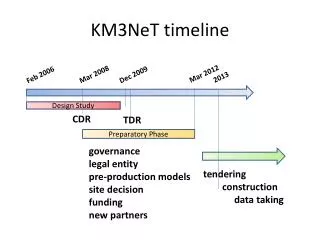
KM3NeT timeline Mar 2012 2013 Feb 2006 Mar 2008 Dec 2009 Design Study CDR TDR Preparatory Phase governance legal entity pre-production models site decision funding new partners tendering construction data taking
How to distribute light sensors over many km3 Key parameter: total photo-cathode area • Many optical sensors concentrated on ‘towers’ • horizontal extensions • at large horizontal distances • Few optical sensors on ‘strings’ • Slender string structure • At smaller horizontal distances INFN IN2P3 CEA/Saclay • Nikhef • KVI • - ECAP (Erlangen) • - Demokritos (Greece) Both concepts worked out in the Design Study
The slender string Same area photocathode + Calibration instrumentation + Electronics in one sphere Multi-PMT Optical Module • Advantage: • Uniform angular acceptance • Photon counting • Good background rejection
Multi PMT Optical Module Custom HV board (4.5 mW) with amplifier and discriminator ~20 mW Bit of effort to get all electronics in and keep power down and get heat out
Slender string • Small diameter ropes for mechanical strength • 20 Multi-PMT optical modules • 4 empty spheres for buoyancy • Small diameter, oil-filled e/o cable for (data)communication • 10 Gb/s communication network • ~900 m long • KM3NeT: 640 strings
Launcher on deck String (~900 m) wound onto launcher (NIOZ) Dense packing: 37 spheres anchor
Deployment Release 1 Buoyancy for release 16-12-2009 Pylos 850 m depth Release 2 hook Anchor
Recovery of LOM-frame 16-12-2009 Pylos 850 m depth
Buoy OM OM OM ~8 km3 640 slender strings 12800 optical modules 200-250 MEuro OM OM Oil filled flexible vertical e/o cable 10 kV / 400V Branch cable network on the seabed Junction box
KM3NeT sensitivity IceCube 10-9 10-10 10 6 8 4 2 Galactic sources observation time [years]
Alternatives + separate electronics container 6 m 2.5 m
KM3NeT TDR • Point-to-point optical network accepted • Multi-PMT optical module needs further tests • Both DU-designs need further tests: • deployment, stability after deployment • Decisions ultimately end 2011 • Final prototyping in 2012 • Construction starts in 2013
At Nikhef for KM3NeT2010 • Improvement simulation/reconstruction software for string design; foot print of detector • Prototype optical 10 Gb/s point-to-point network • Development board for interface to network • Development of flexible oil-filled vertical e/o cable • Prototype of Multi-PMT optical module • Together with NIOZ: development of launcher for deployment • Design of assembly procedure + tooling + test setups for Multi-PMT optical module
go / nogotest go / nogotest go / nogotest Test stationN flushing Press. Validatione/o validation Burn in Assembly of Multi-PMT OM 1. lower hemisphere addoptical gel 1.1 1.2 1.3 1.4 1.5 1.6 1.7 A 2. upper hemisphere • Tooling for handling of glass spheres • Test setups for PMTs • Dark room/boxes • (Cleanish) room for parallel assembly lines • Storage room glue 2.1 2.2 2.3 2.4 2.5 2.6 addoptical gel 2.11 2.10 2.12 2.8 2.9 2.7 2.13 B B 3. closing the sphere A storage 3.1 3.3 3.2 3.6 3.5 3.4
At Nikhef for KM3NeT2011-2012 • Prototype optical network • Prototype slender string • Development of assembly line + test setups for optical modules and detection units Depending on KM3NeT decisions (external review): • Production preparation for slender string: • multi-PMT optical module • vertical e/o cable
Nikhef for KM3NeT2013 - 2017 Construction: • optical network electronics • assembly of optical modules and electronics • assembly of detection units
KM3NeT PP • Nikhef+Saclay coordinate prototyping and design of assembly/integration lines • Specific coordination tasks Nikhef: • Optical Module • Design Assembly lines