Download
1 / 6
60 likes | 188 Vues
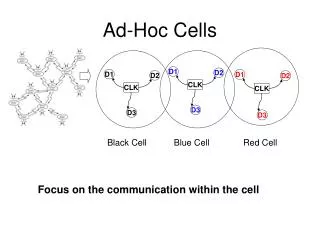
This article explores the intricate communication dynamics within Ad-Hoc cells, highlighting the role of transmitters and receivers. It delves into the Time Division Multiple Access (TDMA) and Frequency Division Multiple Access (FDMA) schemes, showcasing how signals are organized and transmitted in these cellular networks. Using examples such as the interaction between Dust Particle sensors and processing units, the use of Frequency Shift Keying (FSK) for signal transmission is explained. This analysis provides insights into managing communication efficiency in dynamic environments.

E N D
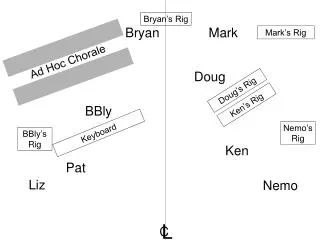
D1 D1 D1 D2 D2 D2 CLK CLK CLK D3 D3 D3 Ad-Hoc Cells Black Cell Blue Cell Red Cell Focus on the communication within the cell
Signal TDMA Time Signal TDMA/FDMA FDMA Frequency time Frequency Multiplexing Scheme: TDMA/FDMA Signal
D1 D2 CLK D3 Example of One Ad-Hoc Cell Central CLK is slow, comm w/ everyone, separates T1,T2,T3 D1 = Dust Particle 1
Tx Sensor ADC Rx L1 CPU L2 Dust Detail Digital Signal --- Binary Frequency Shift Keying (BFSK) in transmiter
f1 f1 f3 f2 f1-Rb f1+Rb f1-Rb f2-Rb f3-Rb f3+Rb f1+Rb f2+Rb Use FSK-Based Transceivers Amplitude Amplitude Frequency Frequency