Introduction to Geochemistry: Understanding Earth's Chemical Composition
330 likes | 384 Vues
Explore the significance of geochemistry in studying Earth's chemical processes, cycles, and interactions with its surroundings. Topics include elemental formation, aqueous solutions, redox reactions, and stable isotopes.


Introduction to Geochemistry: Understanding Earth's Chemical Composition
E N D
Presentation Transcript
Environmental Geochemistry January 26, 2007
What is geochemistry? The study of -chemical composition of the Earth and other planets -chemical processes and reactions that govern the composition of rocks and soils -the cycles of matter and energy that transport the Earth's chemical components in time and space -and their interaction with the hydrosphere and the atmosphere.
Outline of Topics • Formation of the elements • Composition of Earth • Aqueous Solutions • Chemical Equilibrium • Acid-Base Equilibria • Redox • Biogeochemistry • Stable Isotopes (with comments on weathering, sorption, pollution…)
Aqueous Solutions Water is special
Ionic Strength I = 1/2 ∑mz2
Chemical Equilibrium Exists when a system is in a state of minimum energy (G) • - Often not completely attained in nature (e.g., photosynthesis leaves products out of chemical equilibrium) • - A good approximation of real world • Gives direction in which changes can take place (in the absence of energy input.) • Systems, including biological systems, can only move toward equilibrium. • -Gives a rough approximation for calculating rates of processes because, in • general, the farther a system is from equilibrium, the more rapidly it will move • toward equilibrium; however, it is generally not possible to calculate reaction rates from thermodynamic data.
2 3 3 3 Acid-Base Equilibria Bronsted-Lowry definition: acid donates H+; base accepts H+ In aqueous systems, all acids stronger that H2O generate excess H+ ions (or H3O+); all bases stronger than H2O generate excess OH-
Acid-Base Many reactions influence pH Photosynthesis and respiration are acid base reactions. aCO2(g) + bNO3- + cHPO42- + dSO42- + f Na+ + gCa2+ + hMg2+ iK+ + mH2O + (b + 2c + 2d -f -2g - 2h - i)H+<-----> {CaNbPcSdNafCagMghKiH2Om}biomass + (a + 2b)O2 Oxidation reactions often produce acidity. Reduction reactions consume acidity pH influences many processes -weathering (Fe and Al more soluble at lower pH) -cation exchange (leaching of base cations from soil due to acid rain) -sorption(influences surface charge on minerals and therefore what sticks to them)
Acid-Base Alkalinity ≈ ANC Alkalinity = ∑(base cations) - ∑(strong acid anions) Any process that affects the balance between base cations and acid anions must affect alkalinity.
Redox • The oxidation state of an atom is defined with the following • convention: • The oxidation state of an atom in an elemental form is 0. • In O2, O is in the 0 oxidation state. • When bonded to something else, oxygen is in oxidation • state -2 and hydrogen is in oxidation state of +1 (except for • peroxide and superoxide). • In CO32-, O is in -2 state, C is in +4 state. • The oxidation state of a single-atom ion is the charge on • the ion. • For Fe2+, Fe is in +2 oxidation state.
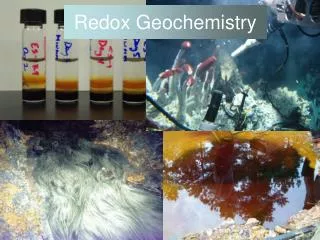
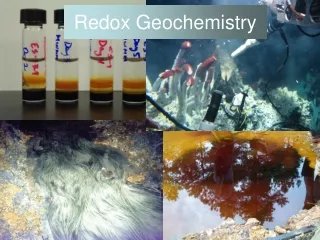
Redox Redox reactions tend to be slow and are often out of thermodynamic equilibrium - but life exploits redox disequilibrium. Oxidation - lose electrons Reduction - gain electrons Fe was oxidized, Mn was reduced
Why do we care about redox rxns? Oxidation state can impact • Sorption/desorption • Solubility • Toxicity • Biological uptake etc. Measure of oxidation-reduction potential gives us info about chemical species present and microbes we may find.
Accumulation of O2 in the Atmosphere Fe2+ = Fe(II) = slightly soluble in sea water with no O2 present Add O2 - oxidizes Fe(II)-->Fe(III) Very small [O2] required Fe3+ = Fe(III) = extremely insoluble in water Essentially all of the oxygen in the atmosphere came from photosynthesis
Nitrification ammonia→ nitrite → nitrate Denitrification nitrate → nitrite → nitric oxide → nitrous oxide → N2 N Fixation N2 →ammonia
What is an isotope? • Isotope- line of equal Z. It has the same # protons (ie. they are the same element) but a diff. # of neutrons. 14N 15N 12C 13C 14C 10B 11B
How did all this stuff get here? • 4 types of isotopes, based on how they formed: • Primordial (formed w/ the universe) • Cosmogenic (made in the atmosphere) • Anthropogenic (made in bombs, etc) • Radiogenic (formed as a decay product)
Stable Isotopes Light isotopes are fractionated during chemical reactions, phase changes, and biological reactions, leading to geographical variations in their isotopic compositions FRACTIONATION: separation between isotopes on the basis of mass (usually), fractionation factor depends on temperature Bonds between heavier isotopes are harder to break
Stable Isotope Examples • Rayleigh fractionation: light isotopes evaporate more easily, and heavy isotopes rain out more quickly d= {(Rsample – Rstandard) / Rstandard} x 103
Stable Isotope Examples • d18Ocarbonate in forams depends on d18Oseawater as well as T, S • d18Oseawater depends on how much glacial ice there is • Glacial ice is isotopically light b/c of Rayleigh fract. • More ice means higher d18Oseawater
Stable Isotopes • C inorganic matter, fossil fuels, and hydrocarbon gases is depleted in 13C ==> photosynthesis • used as an indicator of their biogenic origin and as a sign for the existence of life in Early Archean time (~ 3.8 billion years ago) • N isotopic composition of groundwater strongly affected by isotope fractionation in soils plus agricultural activities (use of N-fertilizer and discharge of animal waste) • Particulate matter in ocean enriched in 15N by oxidative degradation as particles sink through water column • Used for mixing and sedimentation studies • S isotopes fractionated during reduction of SO42- to S2- by bacteria • didn’t become important until after ~2.35 Ga when photosynthetic S-oxidizing bacteria had increased sulfate concentration in the oceans sufficiently for anaerobic S-reducing bacteria to evolve (photosynthesis preceded S-reduction which was followed by O respiration)
Stable Isotope Examples • Stable isotopes can also tell you about biology • Organisms take up light isotopes preferentially • So, when an organism has higher 30Si, it means that it was feeding from a depleted nutrient pool
Stable Isotopes • Boron isotopes measured in forams used for paleo-pH • d11B depends on pH • (Gary Hemming) • Nitrogen isotopes used for rapid temp. changes in ice cores • d15N depends on temp. gradient in firn • (Jeff Severinghaus) • Stable isotopes are also used to study magmatic processes, water-rock interactions, biological processes and anthropology and various aspects of paleoclimate
References http://mineral.gly.bris.ac.uk/Geochemistry/ http://mineral.gly.bris.ac.uk/envgeochem/ http://www.soest.hawaii.edu/krubin/gg425-sched.html http://geoweb.tamu.edu/courses/geol641/notes.html http://www.imwa.info/Geochemie/Chapters.HTML (WM White Geochemistry Ch9 - Stable Isotopes) Isotopes: Principles and Applications - Faure & Mensing How to Build a Habitable Planet - Wally Broecker