Introduction to VMD (Visual Molecular Dynamics)
90 likes | 312 Vues
This introduction to Visual Molecular Dynamics (VMD) provides essential insights into its capabilities for modeling, visualizing, and analyzing biological systems such as proteins, nucleic acids, and lipid bilayers. VMD can read standard Protein Data Bank (PDB) files, enabling users to visualize molecular structures using various rendering methods, including CPK spheres, licorice bonds, and cartoon drawings. Additionally, VMD facilitates the animation and analysis of molecular dynamics simulations, serving as a graphical frontend for remote simulation programs. Follow the manual for a step-by-step demonstration on using VMD effectively.


Introduction to VMD (Visual Molecular Dynamics)
E N D
Presentation Transcript
Introduction to VMD (Visual Molecular Dynamics) Dr Karina Kubiak - Ossowska High Performance Computing Support Team Department of Physics e-mail: karina.kubiak@strath.ac.uk
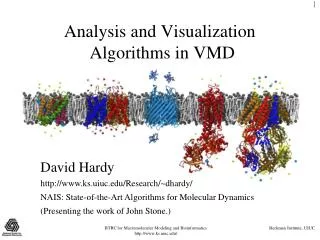
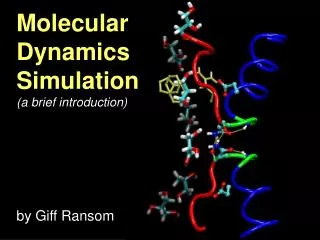
VMD VMD web page: http://www.ks.uiuc.edu/Research/vmd/ Documentation: http://www.ks.uiuc.edu/Research/vmd/current/docs.html VMD is designed for modeling, visualization, and analysis of biological systems such as proteins, nucleic acids, lipid bilayer assemblies, etc. It may be used to view more general molecules, as VMD can read standard Protein Data Bank (PDB) files and display the contained structure. VMD provides a wide variety of methods for rendering and coloring a molecule: simple points and lines, CPK spheres and cylinders, licorice bonds, backbone tubes and ribbons, cartoon drawings, and others. VMD can be used to animate and analyze the trajectory of a molecular dynamics (MD) simulation. In particular, VMD can act as a graphical front end for an external MD program by displaying and animating a molecule undergoing simulation on a remote computer.
VMD Now we will follow the manual and I’ll demonstrate how to use VMD.