Understanding Classical Conditioning: Pavlov and Watson's Experiments on Learning Responses
This overview details the principles of classical conditioning as demonstrated by Ivan Pavlov's pioneering experiments with dogs, where he observed that dogs salivated in response to stimuli associated with food. It explains key concepts like unconditioned stimuli, conditioned responses, and the formation of associations. Additionally, it highlights John Watson's work with Little Albert, showcasing emotional conditioning and stimulus generalization. Together, these foundational studies illustrate how behaviors and emotions can be learned through specific conditioning processes.

Understanding Classical Conditioning: Pavlov and Watson's Experiments on Learning Responses
E N D
Presentation Transcript
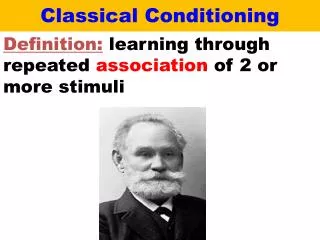
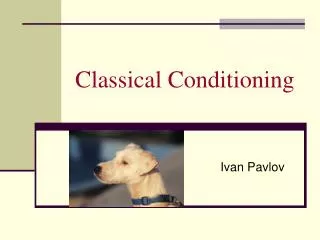
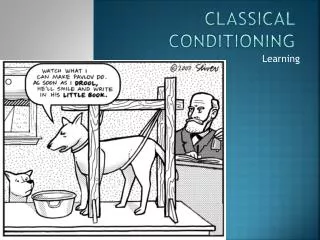
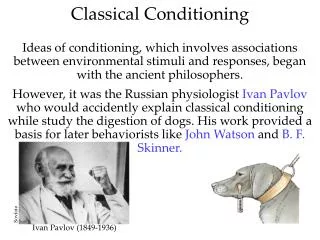
Ivan Pavlov’s Experiment • Originally interested in physiology • Studying effect saliva had on digestion • Noticed dogs began to salivate upon seeing experimenter (even without food)
Example:Ice cube offered (S) Dog comes running (R) Stimulus Response Any action that comes from a stimulus. Anything that causes some kind of reaction.
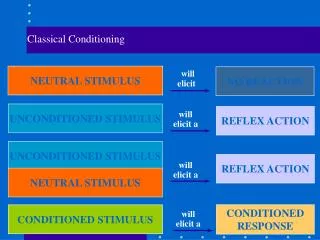
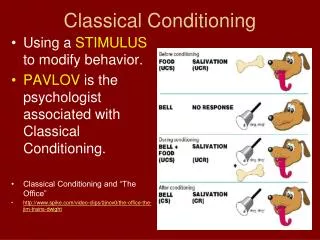
Unconditioned Response to stimulus is natural and automatic. Initial Stage: Unconditioned Stimulus, Unconditioned Response Example:Ice cube offered (US) Dog comes running (UR)
Neutral Stimulus • Stimulus that has no effect to illicit a response • Specific conditions are necessary • An association must be formed Sound of Ice Machine (NS) Ice Cube offered (US) Dog comes running (UR)
Conditioned Stimulus • An association is made between the neutral stimulus and the unconditioned response • Not a firm tie yet; acts as a hint Sound of Ice Machine (CS) Ice Cube offered (US) Dog comes running (UR)
Conditioned Response • Conditioned stimulus now causes a response on its own • Same response, but now in reaction to conditioned stimulus Sound of Ice Machine (CS) Dog comes running (CR)
Emotional Conditioning • John Watson • In charge of lab rats • Got them to do amazing things • Realized it was only through conditioning • Suggested that deep emotions in humans are just learned experiences
Little Albert • 11 month old Albert • Watson gave him a white rat to play with • Made a loud sound to startle Albert and make him cry • Albert soon was scared of the white rat
Identifying the Pieces • Unconditioned Stimulus: • Loud noise • Unconditioned Response: • Fear of loud noise • Neutral Stimulus: • Rat • Conditioned Stimulus: • Rat • Conditioned Stimulus: • Fear of rat
Extension • Stimulus Generalization: response spreads from one specific stimulus to other similar ones • Albert became afraid of white bunnies and other things that resembled the rat. • Extinction: association created through conditioning disappears • When my dogs don’t go on walks for a while, they forget to sit before crossing the street • Spontaneous Recovery: sudden reappearance of an extinguished response