Solving Radical Equations
This guide covers the essentials of solving radical equations, including the Power Rule and methods for handling equations with one or two radicals. A radical equation must include at least one variable-containing radicand. The Power Rule states that if two quantities are equal, raising them to the same power maintains their equality (though resulting equations may not be equivalent). We'll explore how to isolate radicals and verify solutions through a comprehensive step-by-step approach. Practice exercises included for mastering the concepts.

Solving Radical Equations
E N D
Presentation Transcript
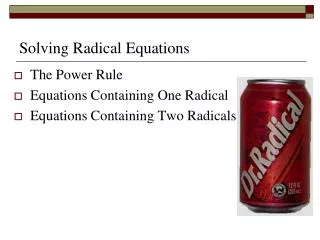
Solving Radical Equations • The Power Rule • Equations Containing One Radical • Equations Containing Two Radicals
Definitions • A Radical Equation must have at least one radicand containing a variable • The Power Rule: • If we raise two equal quantities to the same power, the results are also two equal quantities • If x = y then xn = yn • Warning: These are NOT equivalent Equations!
Why are they not Equivalent? • Start with a simple original equation: • x = 3 • Square both sides to get a new equation: • x2 = 32 which simplifies to x2 = 9 • The only solution to x = 3 is 3 • x2 = 9 has two solutions 3 and -3 • Raising both sides of the equation to an equal power is called an irreversible step. • Therefore we need to check our solutions to make sure they are valid.
Equations Containing One Radical • To eliminate the radical,raise both sides to the index of the radical
Sometimes, You First Need to Isolate the Radical • Get the radical alone before raising to a power