Solving Radical Equations
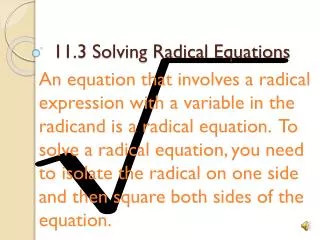
In this lesson on solving radical equations, we explore the method of squaring both sides of an equation. The principle states that if ( a = b ), then ( a^2 = b^2 ). However, it's crucial to be aware that this method can introduce extraneous solutions that do not satisfy the original equation. To solve effectively, isolate the radical expression first, then proceed to square both sides. We will demonstrate step-by-step how to solve radical equations, check solutions, and confirm their validity, ensuring a comprehensive understanding of the topic.

Solving Radical Equations
E N D
Presentation Transcript
Solving Radical Equations Lesson 13.4
Squaring Both Sides of an Equation • If a = b, then a2 = b2 • Squaring both sides of an equation often introduces extraneous solutions of a2 = b2 that are NOT solutions. So when you use this procedure, it is critical that you check each solution in the original equation. • Before squaring both sides of an equation, you should isolate the radical expression on one sideof the equation.
Solving a Radical Equation Goal is to isolate the radical expression. 1. Add 8 to both sides. 2. Square both sides. Simplify Check your solution • Solve
Solve a Radical Equation Goal is to isolate the radical expression. 1. Subtract 1 from both sides. 2. Square both sides. Simplify Solve for x Check your answer • Solve
Solve a Radical Equation Goal is to isolate the radical expression. Square both sides. Simplify Write in standard form. Factor and solve. Check your answer • Solve -1 does not check. So 2 is the only solution.