
Java Programming Language and Translation Techniques
E N D
Presentation Transcript
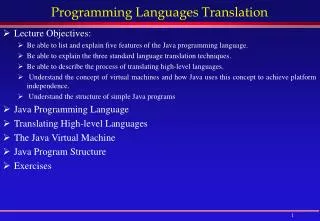
Programming Languages Translation • Lecture Objectives: • Be able to list and explain five features of the Java programming language. • Be able to explain the three standard language translation techniques. • Be able to describe the process of translating high-level languages. • Understand the concept of virtual machines and how Java uses this concept to achieve platform independence. • Understand the structure of simple Java programs • Java Programming Language • Translating High-level Languages • The Java Virtual Machine • Java Program Structure • Exercises
The Java Programming Language • The object-oriented paradigm is becoming increasingly popular compared to other paradigms. • The Java programming language is perhaps the most popular object-oriented language today. • Here are some reasons why Java is popular: • 1. Simple. • Compared to many modern languages, the core of the Java language is simple to master. • 2. Object-oriented. • Java is an object-oriented language and therefore it has all the benefits of OO languages described earlier. • 3. Secure. • The Java system controls what parts of your computer a program access. • 4. Architecture neutral. • A Java program will run identically on every platform. We will explain how Java achieves this portability later in this session. • 5. Java is for Internet applications • Java was designed so that it can download programs over the Internet and execute them.
High Level Language Translators • As mentioned earlier, one of the disadvantages of a high-level language is that it must be translated to machine language. • High-level languages are translated using language translators. • A language translator is that translates a high-level language program or an assembly language program into a machine language program. • There are three types of translators: • 1.Assemblers. • 2.Compilers. • 3.Interpreters.
High Level Language Translators • Assemblers • An assembler is a program that translates an assembly language program, written in a particular assembly language, into a particular machine language. • Compilers • A compiler is a program that translates a high-level language program, written in a particular high-level language, into a particular machine language. • Interpreters • An interpreter is a program that translates a high-level language program, one instruction at a time, into machine language. • As each instruction is translated it is immediately executed. • Interpreted programs are generally slower than compiled programs because compiled programs can be optimized to get faster execution. • Note that: • Some high-level languages are compiled while others are interpreted. • There are also languages, like Java, which are first complied and then interpreted
Compilation Process: Traditional Compilers • In the traditional compilation process, the compiler produces machine code for a specific family of processors • For example, given a source program, a compiler for the x86 family of processors will produce binary files for this family of processors. • A disadvantage of this compilation method is that the code produced in each case is not portable. • To make the resulting code portable, we need the concept of a virtual machine as we discuss in the following page.
Java Virtual Machine • Instead of producing a processor-specific code, Java compilers produce an intermediate code called bytecode. • The bytecode is also a binary code but is not specific to a particular CPU. • A Java compiler will produce exactly the same bytecode no matter what computer system is used. • The Java bytecode is then interpreted by the Java Virtual Machine (JVM) interpreter. • Notice that each type of computer system has its own Java interpreter that can run on that system. • This is how Java achieves compatibility. • It does not matter on what computer system a Java program is compiled, provided the target computer has a Java Virtual machine.
Structure of Simple Java Programs • The following figure shows a simplified structure of Java programs. We will consider a more detailed structure of Java programs later in this course. public classClassName { public static void main(String[] args ){ statement 1 statement 2 * * * statement N } } • A Java program consists of essential elements called classes. The classes in a program are used to create specific things called objects.
Source Program: Example public classSalaam { public static void main(String[] args ){ System.out.println(“Salaam Shabab.”); } } • This is an example of a Java source program • Program execution: the main method is called by the runtime system • You must type this program and save it in a file named Salaam.java