
SlideServe
Menu
Préférences
© SlideServe · v2026

Generation to Generation

jlowry avatar
8 diapositives · 136 Views · Jan 06, 2020

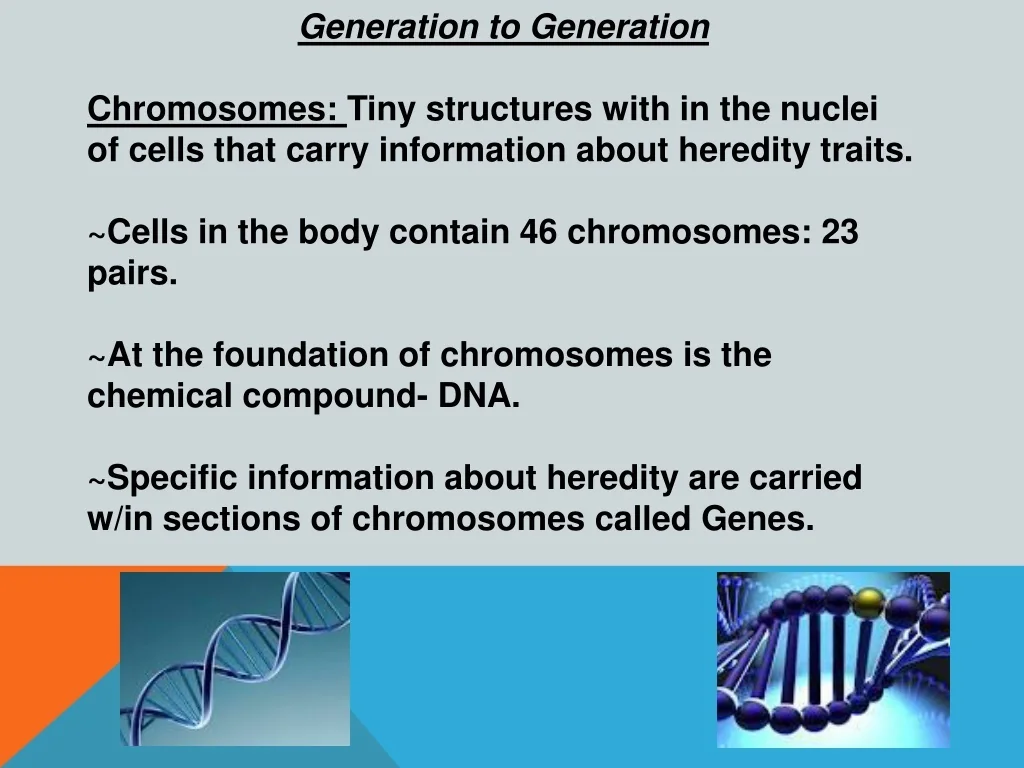
Generation to Generation Chromosomes: Tiny structures with in the nuclei of cells that carry information about heredity traits. ~Cells in the body contain 46 chromosomes: 23 pairs. ~At the foundation of chromosomes is the chemical compound- DNA.
Generation to Generation - slide 1
01 / 8Generation to Generation
1 / 17

Télécharger la présentation

Generation to Generation
Une image / un lien ci-dessous est fourni (tel quel) pour télécharger la présentation

Politique de téléchargement : le contenu du site vous est fourni TEL QUEL pour votre information et votre usage personnel ; il ne peut être vendu, concédé sous licence ni partagé sur d’autres sites sans l’accord de son auteur.Le contenu vous est fourni TEL QUEL, pour votre information et votre usage personnel uniquement. Téléchargez la présentation en cliquant sur ce lien. Lors du téléchargement, si vous ne parvenez pas à télécharger une présentation, l’éditeur a peut-être supprimé le fichier de son serveur.Pendant le téléchargement, si vous ne parvenez pas à obtenir une présentation, le fichier a peut-être été supprimé par l’éditeur.

F I N

Plus de contenu associé

Transcription de la présentation
  1. Generation to Generation Chromosomes: Tiny structures with in the nuclei of cells that carry information about heredity traits. ~Cells in the body contain 46 chromosomes: 23 pairs. ~At the foundation of chromosomes is the chemical compound- DNA. ~Specific information about heredity are carried w/in sections of chromosomes called Genes.

  2. Genes: Segments of DNA molecules are paired. ~Dominant Genes: genes that generally show up in the offspring whenever they are present. ~Recessive Genes: Usually show up only when dominant genes are not present. (Example: Blue eyes are recessive, Brown eyes are dominant. If mom has blue eyes, and dad has brown eyes, most likely the child will have brown eyes.)

  3. Genes & Gender ~A zygote has 46 chromosomes- 23 each parent. ~Males have xy, y is the shorter chromosome. ~Female has xx, both are the same. ~Ova and sperm have only 1 chromosome ~Ova have only x ~Sperm have x or y *The sex of the child is determined by the type of sperm that finds the egg (Ova).

  4. Genetic Disorders Sickle Cell Anemia: Disease occurs when a child inherits the hemoglobin (Oxygen-carrying part of blood) gene from both parents. The red blood cells develop a sickle shape and clump together obstructing blood flow and oxygen to the tissues. ~Symptoms- severe joint and abdominal pain, weakness & kidney disease. Tay-Sachs Disease: Causes destruction of nervous system, blindness, and death during early childhood. Cystic Fibrosis: Makes breathing and digestion difficult, its caused by abnormal genes, one from each parent. Down Syndrome: Caused by a chromosomal abnormality known as Trisony-21,( the presence of three copies of the 21st chromosome). As a result, the affected person has an extra 47th chromosome in all body cells. Risk = 1 in 75 at the age of 40

  5. Identifying Disorders • Ultrasound: Sound waves are used to project light images on a screen. This determines if fetus is in the correct position and how many fetus are in uterus. • Test can determine structural defects such as heart malformations, cleft lip or palate.

  6. 3D Ultrasound

  7. Amniocentesis: A syringe is inserted through the pregnant woman’s abdominal wall into the amniotic fluid surrounding the developing fetus. ~Performed 16-20 weeks after fertilization.

  8. Chorionic Villi Sampling: A small piece of membrane is removed from the Chorion ( a layer of tissue that develops into the placenta). Takes place around the 8th week of fertilization. • This is done earlier then amniocentesis. • Only done if Genetic Disorders are suspected or inherited. • Checks for Genetic Disorders