
Minerals
E N D
Presentation Transcript
Composition of the Sun • Abundance of Light Elements • Rarity of Lithium, Beryllium, Boron • Preference for Even Numbers • Abundance peak at Iron, trailing off after
How Elements Form in Stars • Sun: 4 H He • He + particle Mass 5 – Unstable • He + He Mass 8 – Unstable • He + He + He C • Add more He to make heavier elements • End of the line is iron for energy production • Atoms beyond Iron made in massive stars
What are Planets Made of? • Same material as Sun • Minus the elements that remain mostly in gases • We find this pattern in a certain class of meteorites
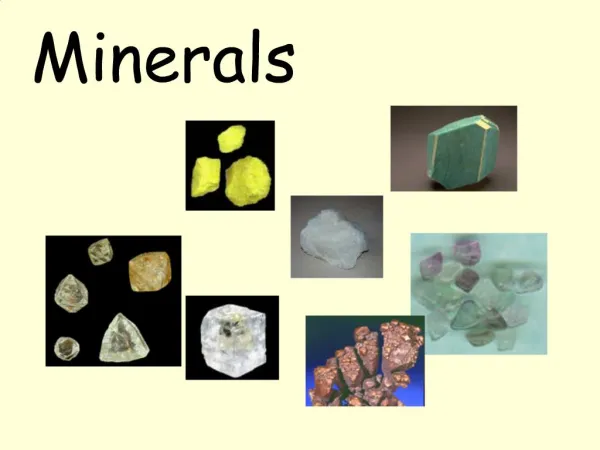
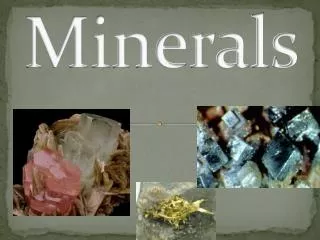
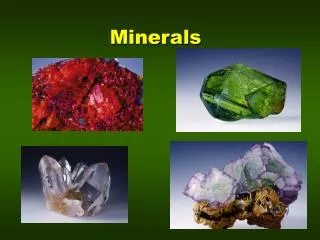
Minerals are the Chemicals that make up the Earth • NATURALLY-OCCURRING • INORGANIC • CHEMICAL COMPOUNDS • ABOUT 3000 KNOWN • 200 COMMON • 20 ROCK-FORMING
Atomic Bonding 1. IONS
Atomic Bonding 2. ELECTRICAL NEUTRALITY • (+) and (-) Cancel Out 3. BONDING (SATISFY 1 & 2) • Ionic (NaCl) • Covalent (O2) • Metallic (Cu, Al, Fe) • Hydrogen (in water)
Summary of Bonding • Ionic bonding holds rocks and minerals together • Covalent bonding holds people and other organisms together • Metallic bonding holds civilization together • Hydrogen bonding gives water its heat-retaining and solvent properties
4. Lattices • Atoms in crystals form a repeating pattern called a Lattice
5. Radicals • Many minerals contain groups of atoms that behave as single units
NAMING MINERALS COLOR • Glauconite (Greek: Glaucos = Blue-green) OTHER PROPERTIES, USES • Magnetite COMPONENTS • Chromite PLACES • Muscovite (Moscow) PEOPLE • Biotite
For Example: Iron Compounds Have Little in Common • Fe: Gray, Metallic • FeCl2: Light Green, Water Soluble • FeSO4: Light Green, Water Soluble • FeCO3: Brown, Fizzes in Acid • FeS2: Dense, Brittle, Metallic, Cubic Crystals
On the Other Hand, Sulfides have Many Properties in Common • FeS2 • CuFeS2 • PbS • ZnS2 All are Dense, Brittle, Metallic, have Cubic Crystals
IDENTIFYING MINERALS COLOR -Sometimes Distinctive • Often Unreliable • Affected By: • Chemical Impurities • Surface Coating • Grain Size • Weathering
IDENTIFYING MINERALS (Continued) HARDNESS • Resistance to Scratching • Directly related to relative strength of atomic bonds • Scratch Test (Mohs) • Indentation Test (Knoop) Common Errors due to: • Weathering, ‘Chalk' marks • Breaking vs. Scratching
Mohs vs. Knoop Scales • Talc: very small • Gypsum, Fingernail: 30 • Calcite, Penny: 135 • Fluorite: 163 • Apatite: 430 • Feldspar, Glass: 560 • Quartz: 820 • Topaz: 1340 • Corundum: 2100 • Diamond: 7000
IDENTIFYING MINERALS (Continued) DENSITY • Directly related to masses of component atoms and their spacing • Usually very consistent
DENSITY - gm/cm3 (weight relative to water ) • Air: 0.001Wood - Balsa: 0.1, Pine: 0.5, Oak: 0.6-0.9Gasoline: 0.7, Motor Oil: 0.9Ice: 0.92Water: 1.00Sugar: 1.59Halite: 2.18Quartz: 2.65Most Major Minerals: 2.6-3.0Aluminum: 2.7
DENSITY • Pyrite, Hematite, Magnetite: 5.0Galena: 7.5Iron: 7.9Copper: 9Lead: 11.4Mercury: 13.6Uranium: 19Gold: 19.3Platinum: 21.4Iridium: 22.4 (densest material on Earth)
IDENTIFYING MINERALS (Continued) LUSTER • Metallic or Nonmetallic is the most important distinction. • Resinous, waxy, silky, etc. are self-explanatory. • Vitreous is often used for glassy luster.
IDENTIFYING MINERALS (Continued) CLEAVAGE • Tendency to split along smooth planes between atoms in crystal • Thus directly related to atomic structure • Related to Crystal Form • Every cleavage face is a possible crystal face • Not every crystal face is a cleavage face. Quartz commonly forms crystals but lacks cleavage.
IDENTIFYING MINERALS (Continued) CRYSTAL FORM • Takes Luck & Practice • Well-formed crystals are uncommon • Crystal Classification is somewhat subtle FRACTURE
IDENTIFYING MINERALS (Continued) GEOLOGIC SETTING • Some minerals occur in all geologic settings: quartz, feldspar, pyrite • Some minerals occur mostly in sedimentary settings: calcite, dolomite • Some minerals occur mostly in igneous settings: olivine • Some minerals occur mostly in metamorphic settings: garnet, kyanite
IDENTIFYING MINERALS (Continued) SPECIAL PROPERTIES • Taste, Magnetism, Etc. EXPERIENCE AND READING PROFESSIONAL METHODS • Chemical Analysis • X-Ray Studies • Thin Section
MAJOR MINERAL SUITES ELEMENTS Metallic:Au, Ag, Cu • Not Al, Pb, Zn, Fe, etc. Nonmetallic: C - Diamond, Graphite • Sulfur
MAJOR MINERAL SUITES SULFIDES: Dense, Usually MetallicMany Major Ores • Pyrite FeS2 • Chalcopyrite CuFeS2 • Galena PbS • Sphalerite ZnS2 • Molybdenite MoS2
MAJOR MINERAL SUITES HALIDES: Usually Soft, Often Soluble • Halite NaCl • Fluorite CaF2 SULFATES: Soft, Light Color • Gypsum CaSO4 • Barite BaSO4
MAJOR MINERAL SUITES OXIDES: Often Variable, Some Ores • Hematite Fe2O3 • Bauxite Al(OH) 3 (a hydroxide) • Corundum Al2O3 (Ruby, Sapphire) CARBONATES: Fizz in Acid, Give off CO2 • Calcite CaCO3 • Dolomite CaMg (CO3)2
MOST IMPORTANT MINERAL SUITE: The Silicate Minerals • Si + O = 75% of Crust • Silicates make up 95% + of all Rocks • SiO4: -4 charge • Link Corner-To-Corner by Sharing Oxygen atoms
Nesosilicates - Isolated Tetrahedra • Representatives: • Garnet • Kyanite • Olivine
Sorosilicates - Paired Tetrahedra Epidote is the most common example
Cyclosilicates - Rings • Beryl (Emerald) • Tourmaline
Inosilicates - Chains Single Chains (Pyroxenes)
Inosilicates - Chains Double Chains (Amphiboles)
Phyllosilicates - Sheets Si2O5 sheets with layers of Mg(OH)2 or Al(OH)3 • Micas • Clay minerals • Talc • Serpentine (asbestos) minerals
Tectosilicates - Three-Dimensional Networks • Quartz Feldspars
Unit Cells All repeating patterns can be described in terms of repeating boxes
The problem in Crystallography is to reason from the outward shape to the unit cell