
Demand Forecasts
E N D
Presentation Transcript
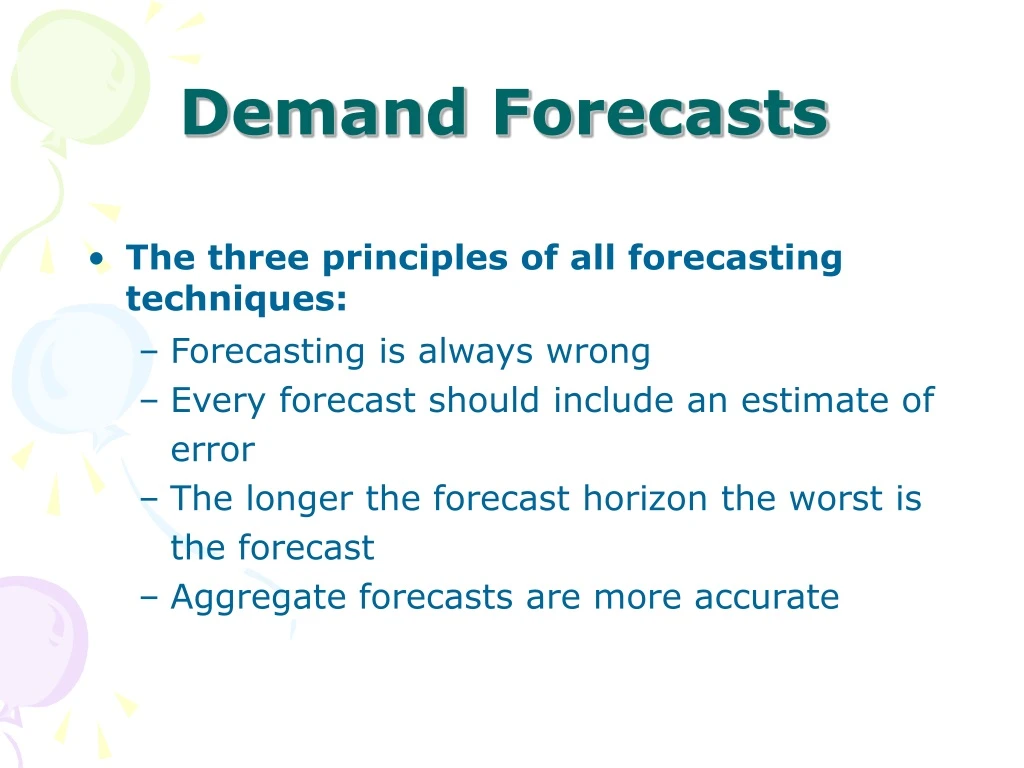
Demand Forecasts • The three principles of all forecasting techniques: • Forecasting is always wrong • Every forecast should include an estimate of error • The longer the forecast horizon the worst is the forecast • Aggregate forecasts are more accurate
Two comments frequently made by managers • We’ve got to have better forecasts • I don’t trust these forecasts or understand where they came from • These comments suggest that forecasts are held in disrepute by many managers
The truth about forecasts • They are always wrong • Sophisticated forecasting techniques do not mean better forecasts • Forecasting is still an art rather than an esoteric science • Avoid single number forecasting • Single number substitutes for the decision
Selecting a forecasting technique • What is the purpose of the forecast? • How is it to be used? • What are the dynamics of the system for which forecast will be made? • How important is the past in estimating the forecast?
Forecasting Techniques • Judgmental methods • Market research methods • Time series methods • Casual methods Qualitative Quantitative
Judgmental methods • Sales-force composite • Panels of experts • Delphi method
Market research method • Markey testing • Market survey
Time Series methods • Moving average • Exponential smoothing • Trend analysis • Seasonality • Use de-seasonalized data for forecast • Forecast de-seasonalized demand • Develop seasonal forecast by applying seasonal index to base forecast
Components of an observation Observed demand (O) = Systematic component (S) + Random component (R) Level (current deseasonalized demand) Trend (growth or decline in demand) Seasonality (predictable seasonal fluctuation)
Causal methods • Single Regression analysis • Multiple Regression analysis
Error measures • MAD • Mean Squared Error (MSE) • Mean Absolute Percentage Error (MAPE) • Bias • Tracking Signal
Collection and preparation of data • Record data in the same terms as needed for forecast • Demand vs. shipment • Time interval should be the same • Record circumstances related to data • Record demand separately for different customer groups
Time Series Forecasting Forecast demand for the next four quarters.