
Governance and Policymaking in Iran: The Basics
E N D
Presentation Transcript
IRAN Part 2: Governance & Policymaking
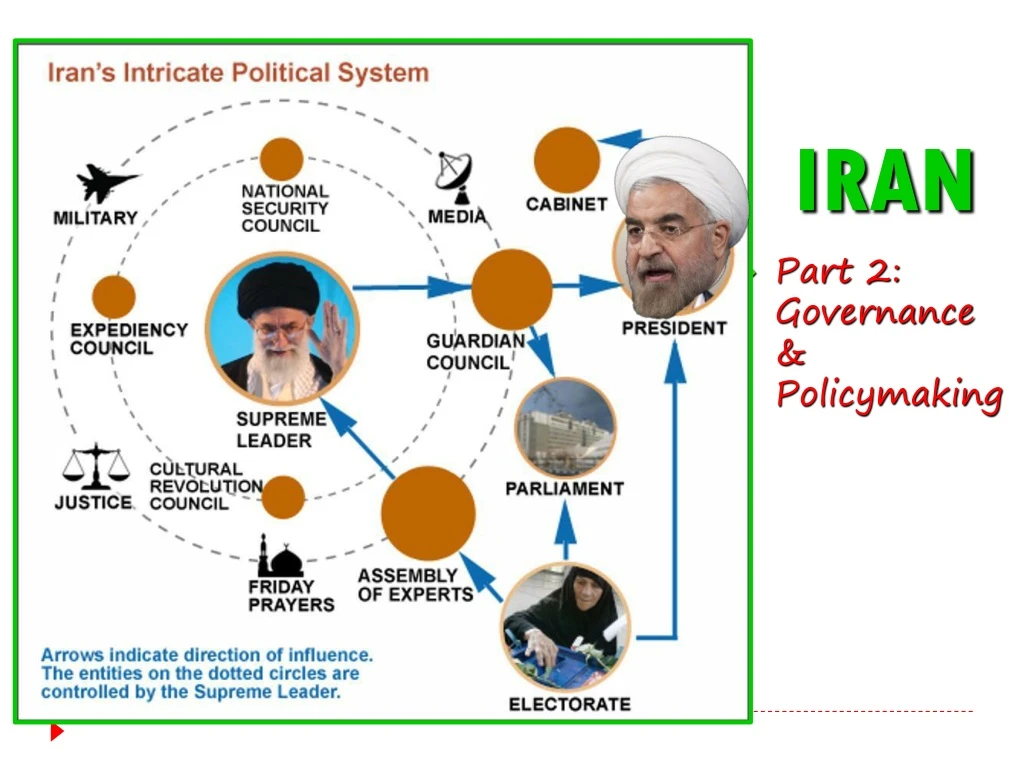
The Basics • Theocratic Republic • Theocracy with democratic elements • Theocratic Institutions: • Supreme Leader • Guardian Council • Assembly of Religious Experts • Expediency Council • Highly Centralized Unitary State • But is divided administratively into provinces, districts, sub-districts, and local areas (local elections allowed since 1999) • Dual Executive (HOS, Supreme Leader; HOG, President) • Unicameral Legislature • Judiciary not independent; Based on Sharia Law
The Supreme Leader (Head of State) • Currently: Ayatollah Ali Khamenei • Most powerful political figure • Chosen by the clerics who make up the Assembly of Experts • Appointed for Life • Expected to act as a trustee of community by supervising politics and ensuring laws conform to Islam • Faqih– leading Islamic jurist to interpret the meaning of religious documents/sharia law
The Supreme Leader • He links 3 branches of gov’t together • Powers: • Limit Presidential candidates • Authority to overrule/dismiss president • Command of armed forces • Declaration of war and peace • Issue decrees for national referenda • Appoint head of judiciary • Appoint half of the members of the Guardian Council • Appoint Friday prayer leaders and the head of radio and TV
The Guardian Council • 12 (all male) member council, serve 6 year terms • 6 clerical members appointed by supreme leader • 6 lay members (lawyers) recommended by head of judiciary, subject to approval of parliament • Council has power to veto any legislation passed by parliament that is at odds with basic tenants of Islam • Vetting Power • Has right to determine who can run in local, presidential, parliamentary, and Assembly of Religious Experts elections • 2012/13: they disqualified thousands of candidates for Majles/Presidential elections
The Assembly of Religious Experts • 86 members (no females) • Directly elected by people for 8 year terms • Elects Supreme Leader & has right to dismiss him • Candidates are subject to approval by Guardian Council
The Expediency Council • 32 members appointed by Supreme Leader • Includes President, chief judge, speaker of the Majles, jurists from Guardian Council • Serve 5 year terms • Designed to settle disputes between Majles and Guardian Council • May originate its own legislation • Why might this be a concern??
The President • Head of Government • Currently: Hassan Rouhani • 4 year term • 8-year consecutive term limit • Directly elected by the people • Universal suffrage (18 or older) • Absolute majority of votes • Top two run a week later • Candidates approved by Guardian Council • 2005 Election disqualified 1,000 candidates (left only 7 to run) • 2009 Election – Accusations/Protests about voter fraud
The President • Qualifications: • Between ages of 25 and 75 • “Well-known personality clause” in constitution allows Guardian Council to bar women • “Shi’ite sect” qualification bars Sunni Muslims, Christians, Jews, Zoroastrians and other religious minorities • Historically a cleric, but not Ahmadinejad • Powers: • Selects vice presidents & cabinet members • Devises budget & presents legislation to parliament • Signs treaties, laws & agreements • Chairs National Security Council • Appoints provincial governors, town mayors & ambassadors
The Bureaucracy • Headed by President • Grown since the revolution • Dominated by clergy • Most important ministries: • Culture and Islamic Guidance (controls media and enforces “proper conduct” in public life) • Intelligence (replaced shah’s SAVAK) • Heavy Industries (manages nationalized factories) • Reconstruction (expands social services and takes “true Islam” to countryside)
The Legislature/Majles • 290 deputies, 4 year terms, SMD • Five guaranteed seats for recognized religious minorities: Christians, Jews, and Zoroastrians • Nonrecognized religious minorities (e.g., Baha’is) cannot run • Direct Elections • Elections held on a nonpartisan basis (ballots do not have party identification or philosophy) • 28 multimember districts (based on population size) • Two round voting: • Candidate must receive at least 25% on first ballot • If more candidates clear this threshold to fill a district’s seats: second round held several months later for top two candidates with the most support
The Legislature/Majles • Qualifications • Candidates submit their names to subcommittee of Guardian Council, which determines who can run • Age 30-75 • Those running for first time must have equivalent of university degree
The Legislature/Majles • NOT a rubber-stamp institution • Powers • Enact/Change laws (with approval of Guardian Council) • Appoint 6 of 12 members of Guardian Council, chosen from a list drawn up by chief judge • Investigate cabinet ministers and public complaints against executive and judiciary • Remove cabinet members (not president) • Approve budget, cabinet appointments, treaties & loans
The Judiciary • Based on Sharia (Islamic) Law – supersedes all other • Qanun– law passed by the Majles – may not contradict Sharia Law • Not independent • Supreme leader appoints head of judiciary who appoints senior judges • Penal Code (Retribution Law)—very strict/harsh • Stoning, death penalty for many “crimes” (adultery, homosexuality, habitual drinking) • Evidence of one male Muslim = evidence of two female Muslims • Modernized penalties, but high rate of executions
The Military • Regular army of 370,000 • According to Constitution, regular army defends the borders, while the Revolutionary Guards protect the republic • Revolutionary Guards (est after 1979) • 125,000 active troops, commanders appointed by Supreme Leader • Has its own ground forces, navy and air force, and oversees Iran's strategic weapons. • Controls the volunteer paramilitary Basij Resistance Force • Control around a third of Iran's economy through a series of subsidiaries and trusts
Bonyads (Charitable Foundations) • Autonomous (directed by clerics/appointed by Supreme Leader) tax exempt charity organizations that control large amounts of money • Foundation for the Oppressed & Disabled • Martyrs Foundation • Most supervise property and state owned businesses • After the Revolution, they were nationalized • Supposed to redistribute income to poor and families of martyrs (i.e. those killed in the service of the country) • Over 100; Monopolize many sectors of the economy (e.g., cement, sugar) • Patronage-oriented holding companies that ensure the channeling of revenues to groups and milieus supporting the regime
Linkage Institutions – Political Parties • Constitution gives citizens the right to organize/assemble • Constitution allows political parties, but they did not emerge until after 1997 election of Khatami • Weak parties have formed – organized around personalities • Parties are unstable & change from election to election • Two major coalitions: Conservative vs Reformist • Parties led by former dissidents (leaders are in exile)
Linkage Institutions – Interest Groups • Very weak • Workers House – one of the few prominent interest groups in Iran • Factory workers • Reform minded • Few business interest groups have formed – the Iranian government controls between 65%-80% of the economy
Linkage Institutions – Mass Media • Speech against the government was a criminal offense after the 1979 revolution • Some of these have been lifted over time • Still a major issue between conservatives & reformers (in terms of access to media/what info is shared by media, etc) • Major radio and TV is gov’t-run by the Islamic Republic of Iran Broadcasting • Some newspapers and magazines are privately owned • Most are non-political (more scholarly) • All publications must have licenses from gov’t – can be revoked at any time; every website must be registered • Since 2010, the gov’t has been building a national network as a substitute for the Internet • Social Media sites from outside of Iran are normally not accessible
Review • Discussion Question: What elements of Iran’s political system make it theocratic? Which elements make it democratic? Theocratic Democratic