Understanding Pass-By-Reference in Functions: Manipulating Multiple Values
Learn how to effectively use pass-by-reference in C++ to return multiple values from functions. This concept is crucial when you need to modify more than one value within the calling function. By passing parameters by reference, changes to the variables within the function directly affect the variables in the calling context. Discover practical examples, such as scaling dimensions of a rectangle and calculating stock price changes, to illustrate the importance of choosing the right parameter passing method for your programming needs.

Understanding Pass-By-Reference in Functions: Manipulating Multiple Values
E N D
Presentation Transcript
03/16/11 Pass-By-Reference
Getting Info Back from a Function • returncan only return one value back to a calling function. • Sometimes you want to pass more than one value.
Example • Want to scale a rectangle in graphic. • One foot is scaled to 1/4 inch. • I want a new measure for both length and width. • Must transmit more than one value by to calling program. • scale.cpp
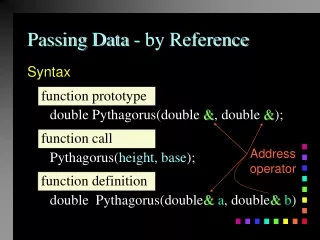
Pass-By-Reference • Syntax void scale(double& ln, double& wd); • & indicates pass-by-reference parameter
Pass-By-Reference • Call: scale(length, width); • Function Heading: void scale(double& ln, double& wd) • ln and wd contain address of length and width • Changes in the parameters affect arguments, length and width.
Stock Function • Write a function that takes the value of a stock today and its value a year ago. It should give the difference in price and the percent change. • e.g. Apple $305.97 Thursday, $225.50 one year ago.
Movie Time Function Write a Function, movieTime( ), that has an integer parameter named minutes and two integer parameters named hours and min. The function is to convert the passed number of minutes a movie lasts into an equivalent number of hours and minutes. Using pass by reference the function should directly alter the respective arguments of the calling function.
Which to Use • Pass-by-reference • Want a change in the associated argument • Pass-by-value • No change wanted in argument • fig5_13.cpp has both
Functions to Improve Programs • Break up into parts • Easier to read • Debug and Test one piece at a time • RPS.cpp
Use Right Kind of Function • One value to return • Function that returns a single value • e.g. double area(double l, double w); • No value to return • void function • e.g. void instructions();
Use Right Kind of Function • More one value to return • void function • Reference parameters • e.g. void scale(double &l, double &w);
To Do • p. 179 #1 & 3 • Read pp. 180-188 • Skipping Recursion at the end of Ch. 5 • A function calling itself. • Generally avoid that. • Can make some problems simpler